GemologyThe Mayuri Journal25 March 2026
Enriched on 19 August 2026
Ruby
Ruby Guide: everything you need to know before buying a ruby jewel
The complete guide to ruby: origins, quality, treatments, pricing and tips for choosing the right one.
Written by Johan Nel, Jewellery designer & goldsmith · trained in gemmology · Mayuri ParisReading 18 min11 chapters
What the maison says
What to remember
There is a Burmese legend that tells of warriors sewing rubies beneath their skin before battle. Not for beauty, but to become invulnerable. In Sanskrit, the stone is called ratnaraj, "king of precious stones." In Mughal India, emperors had their rubies engraved with poems to harness their power. No other stone in history has concentrated such desire, myth, and value.
Ruby is, alongside Emerald and Sapphire, one of the three founding stones of Mayuri's fine jewellery. Its red, whether a pearlescent pink or a deep blood red, belongs to no other mineral family. When we select a Ruby for a ring or a pendant, we seek that colour which transcends the centuries: intense, pure, and alive.
This guide covers Ruby from every angle, from its chemical composition to its care, including the definition of "pigeon's blood," its geographic origins, treatments, symbolism, and the criteria that cause its price to range from $120 to $36,000 per carat. Everything you need to know to choose a Ruby jewel that will last a lifetime, and that you will be able to pass down.
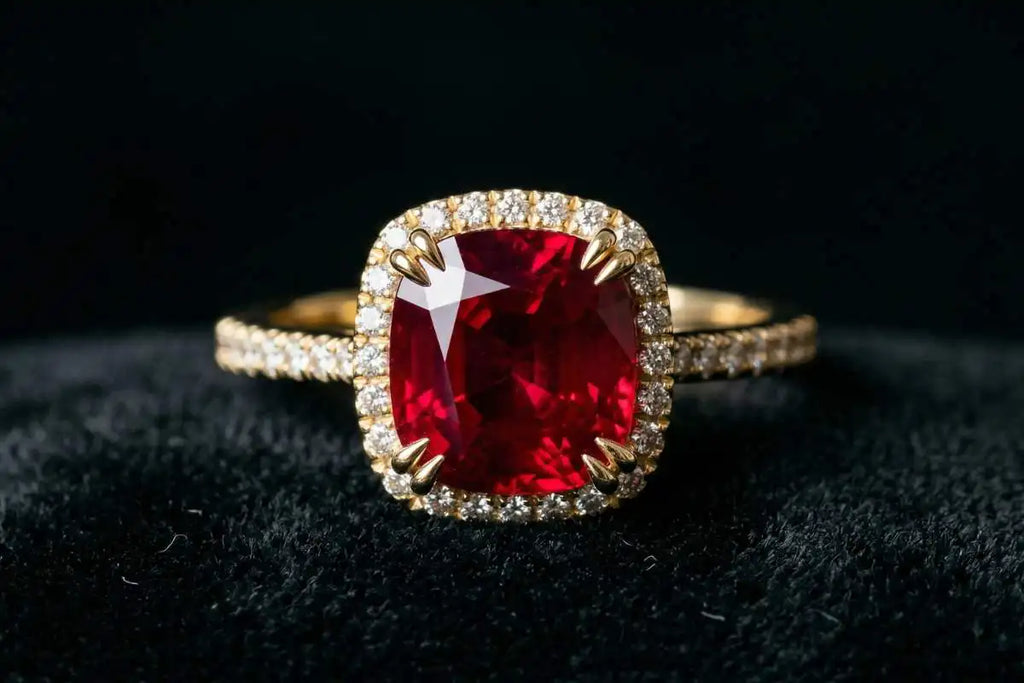
Pigeon's blood ruby ring in 18K yellow gold, Mayuri collection
What is a ruby? Definition and mineralogical family
Ruby is a variety ofcorundum(Al₂O₃, aluminum oxide) whose red color is caused by the presence of chromium ions (Cr³⁺) which substitute for aluminum ions in the crystal lattice. This chemical subtlety is crucial: chromium absorbs the green and blue wavelengths of the visible spectrum, allowing only red to pass through. The higher the chromium concentration, the more intense and saturated the red.
What often surprises is thatruby and sapphire are the same mineral. A red corundum is called ruby. A corundum of any other color (blue, pink, yellow, orange, colorless) is called sapphire. It's not that ruby "resembles" sapphire: it's literally the same crystal structure, the same physical properties, the same mineral family.
In terms of gemmological properties, ruby exhibits exceptional characteristics for jewelry use:
Hardness 9 on the Mohs scale(the 2nd hardest mineral after diamond at 10), well superior to emerald (7.5) or tanzanite (6.5)
Excellent tenacity: the hexagonal structure of corundum gives it shock resistance significantly superior to that of harder but more fragile stones like emerald
Refractive index 1.762-1.770: a bright and deep brilliance, characteristic of high-quality corundums
Density 3.99-4.00 g/cm³: heavier than quartz, slightly lighter than diamond
Dichroism: depending on the viewing axis, the ruby shows two distinct colors, orange-red or violet-red. Cutters orient the cut to maximize the optimal red facing the observer
I don't see the French text you'd like me to translate. Could you please provide the complete French jewelry text that you want translated to English?four precious stonesin the traditional sense of the term, alongside diamond, emerald and sapphire. In France, this distinction is not merely commercial: only diamond, ruby, emerald and sapphire have the right to be designated "precious stones" under decree n°2002-65. All other stones are "fine stones".
I don't see any French text in your message to translate. You've only provided "Sources :" which appears to be a header. Could you please provide the actual French jewelry text that you'd like me to translate?GIA, Ruby Quality FactorsI notice that you've provided semicolons and spaces, but I don't see any French text to translate. Could you please provide the French jewelry text that you'd like me to translate to English? Once you share the actual text, I'll be happy to translate it while preserving all the formatting, source names, and URLs as requested.Hughes, Ruby & Sapphire, 2017I don't see any French jewelry text provided in your message. Could you please share the French text you'd like me to translate?
"Pigeon blood": the most coveted colour in the world
"Pigeon's blood": the expression comes from traditional Burmese descriptions. Merchants from Mandalay compared the ideal color of ruby to that of the eye of a freshly killed dove, a pure red slightly purplish, of incomparable intensity and vividness.
What distinguishes an ordinary ruby from a "pigeon's blood" ruby is not simply a matter of color shade.Two conditions must be met simultaneously: first, the red must be dominant, neither too pink, nor too dark towards burgundy or purple; then, the stone must present astrong red fluorescence under UV lightwhich reinforces and "warms" the color even in artificial light, and gives it this impression of glowing from within.
This fluorescence is possible because rubies rich in chromium re-emit the absorbed UV light as red light. Burmese rubies from Mogok have an exceptionally high chromium concentration, which explains why they naturally and consistently achieve this level of fluorescence. Rubies from other origins, which contain iron in addition to chromium, have their fluorescence inhibited by the iron.
I don't see any French jewelry text to translate in your message. Could you please provide the French text that you'd like me to translate to English?the impact on the price is radical: a Burmese "pigeon's blood" ruby, unheated, certified by GRS, can be worth ten to fifty times the price of a commercial ruby of the same weight and apparent quality. As an example, a 3-carat Burmese pigeon's blood no heat ruby can exceed 100,000 euros at auction at Christie's or Sotheby's. A treated Thai ruby of the same weight would trade for a few thousand euros.
I don't see any French jewelry text in your message to translate. You've only provided "Sources :" which appears to be the beginning of a sources section, but there's no actual content to translate.
Could you please provide the full French text that you'd like me to translate?GRS, Pigeon Blood ClassificationI notice that you've provided semicolons but no French jewelry text to translate. Could you please share the actual French text that you'd like me to translate to English? Once you provide the text, I'll translate it while preserving all formatting, source names, and URLs exactly as requested.Hughes, Ruby & Sapphire, 2017I don't see any French jewelry text in your message. Could you please provide the French text you'd like me to translate?
The origins of the ruby
The geographic origin of a ruby is far from a minor detail. It determines its colour, its characteristic inclusions, its fluorescence, its likelihood of being unheated, and ultimately its price. An origin certificate issued by a recognised laboratory can multiply the value of a stone by three to ten times.
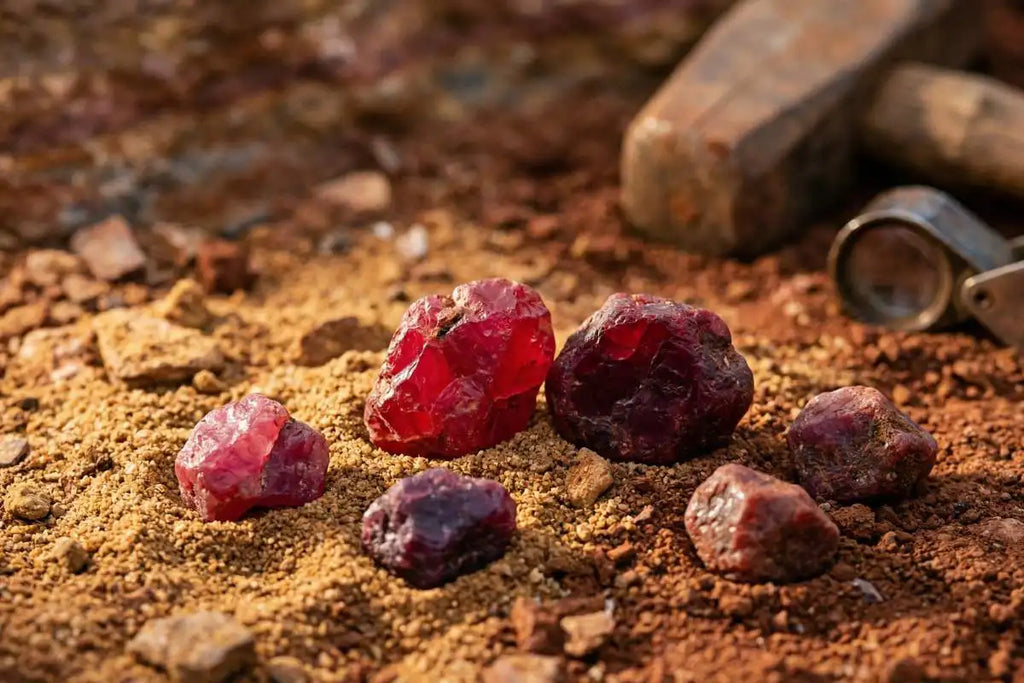
Rough rubies of various origins and shades of red
Burma, Mogok Valley. For more than 400 years, Mogok has produced the most coveted rubies in the world. Its stones display characteristic "silk" inclusions (fine needle-like rutile), an intense red colour naturally enhanced by chromium, and that exceptional UV fluorescence which defines pigeon's blood. Access to the mines and international trade was severely restricted following the sanctions imposed in the wake of the 2021 coup. Burmese rubies remain available on the secondary market and at auction, but the supply of new production is very limited. An origin certificate for Burma/Mogok issued before 2021 retains its full value.
Mozambique, Montepuez. Discovered in 2009, the Montepuez mine, operated by Gemfields, has become the world's leading source by volume since 2012. Their rubies often display a deeper colour and lower fluorescence than Burmese stones, yet their rising quality has swiftly established Mozambique as the benchmark for accessible fine jewellery. Gemfields publishes annual responsibility reports and ensures rigorous traceability from extraction to sale. For ethical fine jewellery, Mozambique is today the source of choice.
Sri Lanka (Ceylon Ruby). Ceylon rubies tend to be more pink than red: beautiful and luminous, yet they frequently sit at the boundary between ruby and pink Sapphire according to GIA definitions. They can reach remarkable quality, particularly older specimens accompanied by a certificate of origin.
Thailand (Chanthaburi). Thailand produces rubies naturally rich in iron, yielding a deeper, less fluorescent red that is less prized than Burmese stones. Chanthaburi, however, has been the global centre for ruby trading and treatment since the 1970s. The vast majority of heated rubies on the market pass through its workshops. Its role is pivotal in the global supply chain, even if its own stones are less sought after.
Origin has a direct impact on price: a certified Mogok no-heat ruby can be worth three to ten times the price of a comparable Mozambican stone of similar colour, and up to twenty times that of a commercial Thai ruby.
The question comes up often, and it deserves a precise answer. If ruby and sapphire are the same mineral, how do we distinguish them?
The answer is in thedominant colorAccording to the GIA, a corundum whose dominant color is red is called ruby. A corundum whose dominant color is pink, blue, yellow, purple or any other hue is called sapphire. The boundary between "ruby" and "pink sapphire" is one of the classic debates in international gemology: there exists a gray zone where the same stone can be classified as ruby by an Asian laboratory and pink sapphire by the GIA.
This boundary is not only cultural. It iseconomically strategic. A pink corundum called "ruby" sells for significantly more than a pink sapphire of comparable quality. This is why Thai merchants have historically tended to classify their stones more liberally as "rubies," while Western laboratories (GIA, SSEF) apply a stricter red threshold.
The consequence for the buyer is direct:only a certificate from a recognized laboratory(GIA, GRS, Gübelin, SSEF) allows for definitive determination. Without a certificate, a seller may call "ruby" what the GIA would classify as "intense pink sapphire". This confusion is not necessarily fraud: it may simply reflect different classification standards according to gemmological tradition.
I notice that you've provided the instruction for translating a French jewelry text, but I don't see the actual French text that needs to be translated. Could you please provide the French text you'd like me to translate to English?GIA, Ruby Quality FactorsI notice that you've provided only a semicolon and some spaces as the text to translate. There doesn't appear to be any French jewelry text with formatting, source names, or URLs to translate.
Could you please provide the actual French text you'd like me to translate?Hughes, Ruby & Sapphire, 2017I don't see any French text provided to translate. Could you please share the French jewelry text that you'd like me to translate to English?
The global ruby market relies very heavily on treated stones. Understanding these treatments is essential for any informed purchase.
Heating (heat treatment)I don't see the French text you'd like me to translate. Could you please provide the French jewelry text that needs translation?90% of rubieson the market. The stone is heated to temperatures between 1,000 and 1,800°C to improve its color (reduce purplish tints, intensify the red) and dissolve certain inclusions. This treatment is permanent, stable over time, and universally accepted by laboratories and the profession. It does not diminish the value of a mainstream ring, even though collectors and investors note it in their criteria.
The ruby "no heat"(unheated) refers to a ruby whose color is natural, without any heat treatment. These stones areconsiderably rarer: statistically, less than 10% of jewelry-quality rubies naturally present sufficient color without heating. At equal quality, a certified no heat ruby is worth two to ten times more than a comparable heated ruby. This price difference does not reflect a visible difference in beauty to the naked eye, but rather the intrinsic rarity and collectible value.
Lead glass fracture filling(lead-glass filling or composite ruby) is a radically different, and radically problematic treatment. Fractures running through the stone are filled with lead-containing glass to improve transparency and mask defects. These stones are sometimes called "composite rubies" or "treated low-grade rubies".Lead glass melts between 300 and 500 °C: it is irreparably destroyed upon contact with ultrasound, steam, acidic cleaning products, and even a soldering flame during ring resizing in a workshop. The destruction is permanent, the stone cannot be repaired.
The absolute rule:know the treatment of your ruby before any professional maintenance. If you do not have a laboratory certificate, inform your jeweler before any ultrasonic cleaning.
At Mayuri, we only use natural rubies. Heat treatment is the only treatment we accept. We never use lead glass-filled rubies or rubies treated by color or resin injection.
Ruby has one of the widest price ranges of any precious gemstone, spanning from $120 per carat for a treated commercial quality stone, to $35,000 per carat and beyond for a certified GRS unheated Burmese pigeon's blood ruby. No other mineral, with the exception of fancy colour diamonds or certain exceptional emeralds, covers such a broad range.
Grade
Characteristics
Indicative price / ct
Jewellery example
Commercial quality
Treated (heated or filled), Thailand / Madagascar, variable colour, no certificate
$120 – $600
Ring $250 – $950
Fine jewellery
Certified heated, Mozambique or Sri Lanka, good to very good red, GIA or GRS certificate
$600 – $3,500
Ring $1,800 – $9,500
Fine quality
Certified heated, premium Burma or Mozambique, intense red, GRS or Gübelin certificate
The Ruby is the official birthstone for the month of July according to the AGTA (American Gem Trade Association) list, adopted in the early twentieth century and universally recognised within the Western tradition.
For those born under Cancer (June 21 to July 22) and Leo (July 23 to August 22), the Ruby is associated with vitality, courage, and leadership in Vedic traditions. In Indian astrology (Jyotish), it is the stone of the Sun (Surya), the planet that governs the ego, dignity, and authority. Wearing a fine natural Ruby is said to strengthen self-confidence and charismatic presence.
Gifting a Ruby jewel for a July birthday is a natural choice, rich with symbolism. The Ruby is also associated with the Ruby anniversary, the fortieth wedding anniversary, according to French and European tradition.
After decades of white diamond dominance, the Ruby engagement ring is experiencing a remarkable resurgence since 2015. Katy Perry and Travis Barker, Eva Longoria, and more recently several royal figures from Southeast Asia: the Ruby is once again establishing itself as the symbol of passion and bold choice.
The case for Ruby in fine jewellery is compelling. With a hardness of 9 on the Mohs scale, the Ruby is ideally suited for everyday wear: far more resilient than Emerald (7.5), more durable than tanzanite (6.5), and virtually scratch-proof against the materials of daily life. A Ruby ring is not only beautiful; it is built to last for generations.
The most sought-after styles: the Ruby solitaire set in 18K yellow gold (the Ruby's deep red is beautifully enhanced by the warmth of yellow gold), and the white Diamond halo, which creates a striking contrast and maximises the brilliance of the centre stone. Rose gold, a more contemporary choice, brings a warm, romantic harmony to the Ruby's rich red.
Historically, the Ruby engagement ring long predates the diamond tradition: Catherine of Aragon in the sixteenth century, the Mughal maharajas, and the imperial courts of Asia and Europe all favoured the Ruby for their most significant betrothal pieces.
Caring for a Ruby jewel is straightforward, with one essential condition: knowing the treatment of your stone.
For a heated ruby (the vast majority on the market): lukewarm water and mild soap (such as Marseille soap or gentle dish soap), a soft-bristled toothbrush, thorough rinsing, and drying with a lint-free cloth. Ultrasonic cleaning is acceptable for securely set heated rubies, provided the setting is in good condition.
For a lead glass-filled ruby: never ultrasonic, never steam, never acidic products. The damage is irreversible. If you do not have a certificate and are unsure of the treatment, always inform your jeweller before any professional cleaning.
Common-sense rules for all rubies: remove your jewellery before swimming (chlorinated water), intense sport, gardening (risk of impacts and scratches on the setting), and any work involving household chemicals. Store separately from other jewellery to avoid stones scratching one another.
Ruby traverses all civilizations and all foundational texts of humanity with remarkable constancy. This universal presence is not a coincidence:no other stone has the same ability to capture the gazeby its intense red, to evoke blood, fire, the sun, passion.
In Sanskrit, ruby is calledratnaraj, "king of precious stones". It occupies the first place in the Navaratna, the nine Vedic stones arranged in amulets that bring protection and luck. In Indian astrology, it is the stone of the Sun (Surya): vitality, prestige, charismatic leadership. The Mughal maharajas had their most beautiful rubies engraved with Quranic verses to amplify their spiritual power.
In Burma, warriors would sew rubies under their skin to become invulnerable. In Rome, the ruby was associated with Mars, the god of war and virility. In medieval Europe, kings and bishops wore rubies on their ceremonial rings to symbolize the power of royal blood and divine protection. In imperial China, high officials wore rubies on their court headdresses, a symbol of the highest ranks.
In literature, ruby is omnipresent. The Bible cites the stone in Proverbs (8:11): "Wisdom is better than rubies." In theOne Thousand and One Nights, Sinbad discovers during his third voyage an entire valley carpeted with rubies guarded by giant serpents. Shakespeare, inA Midsummer Night's Dream, refers to it as a symbol of beauty and royal passion.
The perhaps most revealing anecdote:Christopher Columbus believed he had found rubies in Americaduring his explorations. What he brought back to the Spanish court were only red spinels, a distinct stone but visually similar. The confusion lasted several decades before gemologists resolved it.
Could you please provide the French jewelry text that you'd like me to translate?GIA, Ruby History & LoreI don't see any French jewelry text in your message to translate. Please provide the French text you'd like me to translate to English, and I'll preserve all the formatting, source names, and URLs as requested.
Our ruby jewellery is conceived around a simple principle: colour first Every Ruby we select for a ring, a pendant, Earrings, or a bracelet is individually evaluated by our gemologists for the quality of its red. We seek that frank, vivid intensity that belongs to haute joaillerie, not a diluted pink nor an opaque, dark red.
Our Rubies are set in 18K yellow, white, or rose gold. 18K Yellow Gold is our preferred recommendation for Ruby: the warm yellow magnifies and enriches the red, creating a harmonious, inviting interplay of colour rooted in the great traditions of Indian and French jewellery. White gold creates a more graphic, contemporary contrast. Rose gold brings a romantic softness.
On treatments: our Rubies are natural. Thermal heating is the only treatment we accept, and we are fully transparent about this with every client. We never use lead-glass filled Rubies or stones treated with colour or resin injection.
For exceptional pieces, Mayuri can source Rubies of all qualities, including unheated Burmese Rubies of several carats or stones certified "pigeon's blood" by GRS. These pieces represent rare gemological investments, available on request for clients who wish to access our private selection.
What is the difference between a ruby and a pink Sapphire?
They are exactly the same mineral: corundum (Al₂O₃). The distinction comes down to dominant colour. According to the GIA, a corundum in which red is dominant is called a Ruby; one in which pink dominates is a pink Sapphire. This boundary is scientifically defined by gemological laboratories such as the GIA and GRS, yet it remains a subject of debate between Western and Asian traditions. Without a laboratory certificate, it is impossible to determine this with the naked eye.
How can you tell if a ruby is of "pigeon blood" quality?
Only a certificate from a recognised gemological laboratory can assign this classification. GRS (Gem Research Swisslab) in particular uses the term "pigeon blood" as an official designation, which appears explicitly on the certificate. The Gübelin Gem Lab uses "vivid red." A seller who claims a Ruby is "pigeon's blood" without presenting a GRS or Gübelin certificate cannot support that claim in any verifiable way.
Can a ruby jewel be cleaned with ultrasound at the jeweller's?
Only if the Ruby has not been lead-glass filled. Ultrasonic cleaning is acceptable for a heated Ruby (the most common treatment), but it irreparably destroys a lead-glass composite Ruby, as the glass melts under vibration. Always verify the treatment via a laboratory report before any professional cleaning. In the absence of a certificate, inform your jeweller of your uncertainty without exception.
What is the price of a quality natural Ruby?
Prices range from approximately $120 per carat for a treated commercial-quality stone, to $35,000 per carat and beyond for a GRS-certified unheated Burmese pigeon's blood Ruby. For a fine jewellery ring in 18K gold set with a beautiful certified Mozambican Ruby, expect to invest from $1,800 to $5,000 depending on the weight and quality of the stone. Prestige pieces featuring Burmese, no-heat, pigeon's blood Rubies begin at $12,000 to $18,000.
Is Burmese Ruby still available to purchase?
Yes, but with important precautions. The international sanctions adopted following the 2021 coup in Burma significantly restrict the importation of new Burmese production into the European Union and the United States. However, Burmese Rubies extracted and certified before these restrictions, as well as stones circulating on the international secondary market, remain available and may be purchased legally. A dated certificate of origin and full traceability documentation are essential for any significant purchase of a Burmese Ruby.
What is the difference between a heated Ruby and a "no heat" Ruby?
There is no visible difference to the naked eye, even for an experienced gemologist. Only laboratory spectroscopic analysis, including UV-Vis, FTIR, and Raman spectroscopy, can determine whether a Ruby has been heated. A certified no-heat Ruby is worth two to ten times more at equivalent quality, not because it is more beautiful, but because it is considerably rarer: statistically, fewer than 10% of gem-quality Rubies display sufficient colour naturally, without heating. No-heat certification is therefore both an attestation of rarity and a guarantee of complete naturalness.