Care TipsThe Mayuri Journal15 January 2025
Enriched on 8 March 2026
Care Tips
How to care for your diamond wedding band?
Discover proven methods to clean your diamond wedding ring at home. Follow our guide to restore your ring's original brilliance and sparkle.
Written by Déborah Baid, Founder · Mayuri ParisReading 5 min9 chapters
What the maison says
What to remember
Your diamond-set wedding ring is a precious jewel worn every day. It is constantly exposed to contact with skin, cosmetics, and household products. Diamond is the hardest material in the world (10 on the Mohs scale), yet it is the setting itself, whether prong, pave, or channel, that remains most vulnerable. Protecting the diamond means, above all, protecting its mount.
Many guides stop at "soapy water and a soft brush." This article goes further: we explain how to tailor your care routine to your specific setting type, whether prong, pave, bezel, channel, or eternity, to preserve the brilliance of your diamonds and the integrity of your wedding ring.
Why does your diamond lose its brilliance?
Diamond has a high surface energy and a naturally hydrophobic character. In practice, its surface attracts fats and oils: finger sebum, hand creams, cooking oils, soap residue. This invisible film reduces the refraction of light through the stone, dulling the brilliance and "fire" of the Diamond.
Hard water also leaves white deposits on the surface, while chlorine (from swimming pools) can tarnish the metal of the setting. Dust, textile fibres, and cosmetic residue accumulate between the prongs and beneath the stone, in areas that are difficult to reach.
Diamond is highly resistant to scratching (only another diamond can scratch it), yet it is not indestructible. An impact along a cleavage plane can cause it to split. It is the 18K yellow gold setting (hardness 3 to 3.5 on the Mohs scale) that tends to wear down most quickly with daily use.
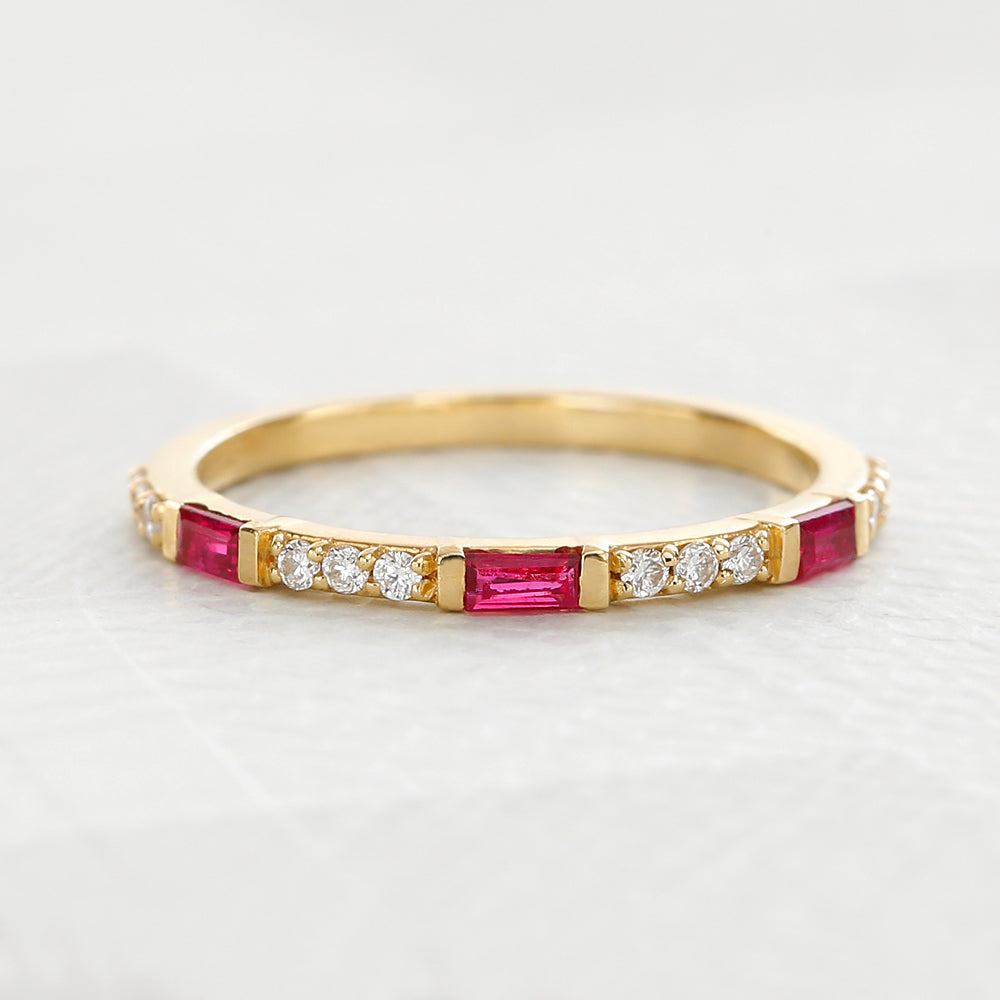
Sushma wedding ring in 18K yellow gold, graduated diamond setting by Mayuri
What to know before cleaning your diamond wedding ring
Before cleaning, identify your setting type:
Prong setting: four or six prongs hold the stone in place. This is the setting most exposed to catching and snagging.
Pave setting: multiple small diamonds are held by very fine micro-prongs.
Bezel setting (rub-over): the metal encircles the stone entirely around its perimeter.
Channel setting: diamonds are set between two parallel metal rails.
Eternity wedding ring: the diamonds encircle the entire band
Also consider the metal: yellow gold, white gold (rhodium-plated) or rose gold, as the care instructions differ slightly.
If your diamond has visible inclusions (SI2 grade or lower), certain cleaning methods such as ultrasonic cleaning are not recommended. Your GIA or HRD Antwerp certificate indicates the clarity grade. Mayuri diamonds are selected at GVVS quality (colour G, purity VVS): at this grade, inclusions are invisible to the naked eye and pose no risk with the recommended cleaning methods.
For wedding rings combining diamonds and coloured gemstones (Emeralds, Sapphires, Rubies), always adapt your cleaning method to the most delicate stone.
Gentle at-home cleaning method: step by step
Prepare: a bowl of lukewarm water (30-40 degrees) with a few drops of gentle dish soap or Marseille soap. Avoid hot water, as thermal shock can weaken the setting.
Soak: gently place the wedding ring in the solution and leave to soak for 20 to 30 minutes. Grease and residue will gradually dissolve.
Brush: gently scrub with a soft-bristled brush (an old toothbrush works well). Focus on the underside of the stone, between the prongs, and the inside of the band, using light circular motions.
Rinse: under a gentle stream of lukewarm water, over a bowl or with the drain closed. Make sure no soap residue remains between the prongs.
Dry: pat dry immediately with a lint-free microfibre cloth or a jewellery polishing cloth. Do not leave to air dry, as this may cause limescale marks.
This method is universal and risk-free for all setting types. For precautions specific to each setting style, please refer to the following section.
Care guide by setting type
Every setting style has its own vulnerabilities and care considerations. A high-quality artisan setting, like Mayuri's hand-crafted settings finished with binocular loupe inspection, holds up far better to daily wear than an industrial setting.
Claw setting (solitaire, 4 or 6 claws)
The prongs extend outward and can catch on clothing or gradually open over time. This is the most exposed setting style.
For cleaning, gently brush between the prongs and beneath the stone, where buildup tends to accumulate most. Use the tip of the brush to reach these tight areas.
Inspection: run your fingernail over each prong. It should feel smooth, with no snagging. If a prong catches, consult a jeweller immediately. Recommended frequency: every 6 months for daily wear.
Pavé setting (multiple small diamonds)
The micro-prongs between the diamonds are extremely fine. Residue builds up between the stones and can be difficult to dislodge.
Use a very soft-bristled brush with a light sweeping motion, never applying strong pressure. Extended soaking (30 minutes) is particularly effective at loosening deposits between the stones.
Check regularly that no small stone moves. Gently shake the wedding ring near your ear: a "clicking" sound is a warning sign. Avoid ultrasonic cleaning if the pavé is older or if you suspect a worn micro-prong.
Bezel setting (closed setting)
The metal wraps around and protects the stone along its entire perimeter. This is the most secure setting style for everyday wear.
The area between the metal and the stone can accumulate deposits. Opt for an extended soak followed by gentle brushing along the edge of the setting. Check that the rim feels perfectly smooth, with no bumps, as these may indicate an impact.
Channel setting (rail)
The diamonds are held between two parallel metal rails. Deposits settle into the channels between the stones.
Use the side edge of the brush to reach the spaces between the stones. Soaking is essential, as mechanical access is limited. If a diamond appears uneven, sitting higher or lower than the others, do not attempt to reposition it yourself: consult a jeweller.
Moksha wedding ring in 18K gold set with baguette cut diamonds by Mayuri
Eternity ring (diamonds set all the way around the band)
A larger set surface means greater exposure to buildup and impact across the entire band.
Extended soaking is essential (a minimum of 30 minutes). Brush along the full circumference, rotating the wedding ring as you go. Dry each section carefully.
An eternity wedding ring cannot be resized (diamonds are set all around). Always store it separately from other jewellery to avoid impact damage.
Thermal shock weakens the setting (expansion and contraction of the metal)
Toothpaste
Micro-abrasives scratch the metal of the setting (18K gold = 3-3.5 Mohs)
Bleach or concentrated chlorine
Corrodes gold alloys, discolours rose gold, and damages rhodium plating
White vinegar
Acetic acid attacks copper alloys (particularly rose gold)
Prolonged soaking of more than 2 hours
Risk of loosening adhesive used in certain industrial settings
Hard-bristle brushes
Scratch the metal and displace the micro-prongs of pave settings
For safe home cleaning, you may use: mild soap or neutral washing-up liquid, lukewarm water (86–104°F), a soft-bristled brush, a microfibre cloth or polishing cloth, and a pre-moistened jewellery wipe for a quick refresh.
Ultrasonic cleaning: a good idea or not?
Ultrasonic cleaners are commonly used by professional jewellers. Home versions are increasingly accessible, but are they truly safe for your wedding ring?
Ultrasonic cleaning is suitable when the diamond is securely set (firm prongs, no movement), has few inclusions (VS2 grade or better), when the setting is of artisan quality, and when the device is correctly calibrated.
It is not recommended, however, if the diamond has significant inclusions (SI2, I1, I2), as vibrations can propagate internal fractures. It is also risky if the setting is aged or fragile, or if the wedding ring combines stones of different hardness levels (diamond and Emerald, for example, as Emerald is far more sensitive to vibrations).
Our recommendation: leave ultrasonic cleaning to the professionals who calibrate both frequency and duration. At home, the soapy water and brush method is equally effective and entirely risk-free. A jeweller uses a professional ultrasonic bath followed by steam drying and a prong inspection for an optimal result.
Your diamond wedding ring care calendar
Care gesture
Frequency
Wipe with a microfibre cloth
Daily (after removing)
Rinse with clean water after exposure (pool, sea, sport, cream)
Immediately
Full clean with soapy water and a soft brush
Once a week (daily wear) / Once a month (occasional wear)
Visual check of the settings
Once a month
Professional cleaning at a jeweller
Every 6 months
Full professional inspection of the settings
Once a year
Everyday habits to protect your diamonds
Remove your wedding ring before sport and fitness (impact, acidic perspiration), household chores and washing up (chemical products), gardening, swimming pools (chlorine), sea bathing (salt and abrasive sand, a destructive combination for any setting), and the application of creams, perfumes, and lotions.
Morning order matters: get ready first (cream, perfume, make-up), then put on your jewellery last. Cosmetics contain chemical agents and fatty compounds that deposit directly onto the diamond.
For storage, place each piece in its own jewellery case. A diamond can scratch other jewellery, and other materials can scratch the metal of a setting. When travelling, use an individual jewellery pouch; never a toiletry bag where contact with products is inevitable.
For white gold wedding rings set with diamonds, monitor the wear of the rhodium plating and plan for periodic re-plating (every one to three years) to maintain a bright white finish.
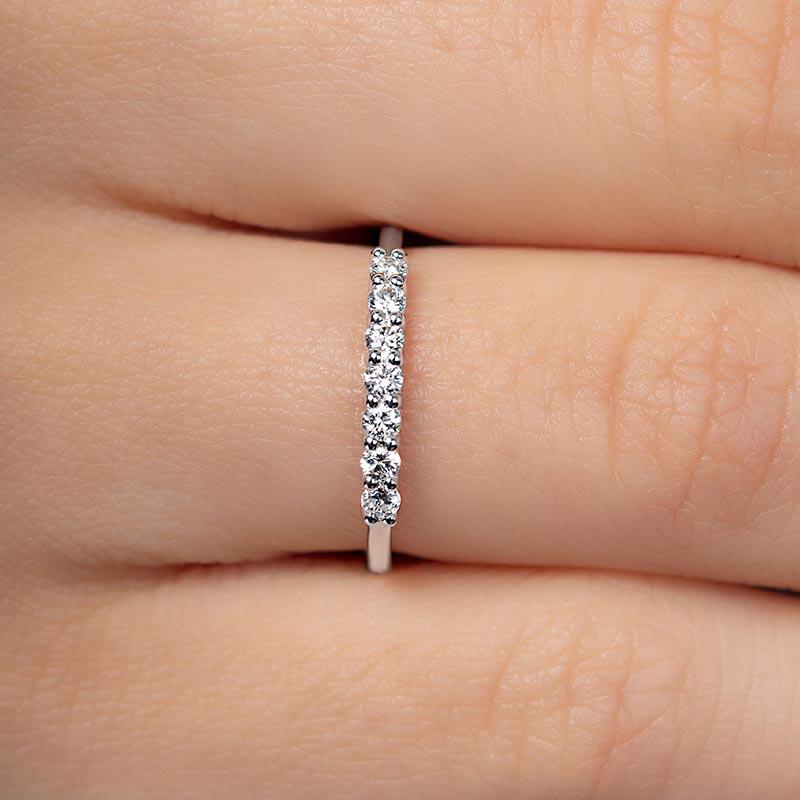
Vadha wedding ring in 18K white gold set with diamonds by Mayuri
Bent or thinned prong: a prong that catches on clothing or hair is an immediate warning sign, indicating a risk of stone loss.
Stone with movement: if the diamond shifts even slightly, have the setting tightened without delay.
Persistently cloudy brilliance: if the diamond remains dull after a thorough home cleaning, deep deposits may require a professional clean.
Deep scratches on the metal: a professional polish restores the surface of 18K yellow gold. Use sparingly, as each polish removes a thin layer of metal.
Re-plating (set white gold wedding rings): when the rhodium wears away, a rhodium-plating bath at a workshop restores the bright white finish (approximately $35 to $60, 30 minutes).
Annual preventive check-up: even when everything appears normal, an annual professional inspection is recommended for set wedding rings worn daily. The prongs wear down in ways that are invisible to the naked eye.
When choosing a professional, look for a jeweller affiliated with the HBJO Federation or a workshop such as Mayuri, which inspects all settings under a binocular loupe.
How do you make a diamond sparkle on a wedding ring?
Soak your wedding ring for 20 to 30 minutes in a bowl of lukewarm water with a few drops of mild washing-up liquid. Gently brush with a soft-bristled brush, paying close attention to the underside of the stone and between the prongs. Rinse under clean water and dry immediately with a microfibre cloth. The Diamond instantly regains its brilliance, as the oils and residues that had dulled its surface are dissolved.
Can a diamond get scratched?
Diamond is the hardest natural material (10 on the Mohs scale): only another diamond can scratch it. The metal of the setting, however (18K yellow gold = 3 to 3.5 on the Mohs scale), scratches far more easily. It is the setting that needs protection, not the stone itself.
What product should you use to clean a diamond ring?
Mild washing-up liquid diluted in lukewarm water is the safest method, recommended by the GIA and professional jewellers alike. Avoid toothpaste (abrasive to metal), vinegar (acidic to alloys), and bleach (corrosive to rhodium plating).
Can a diamond ring be placed in an ultrasonic cleaner?
It depends on the Diamond and the setting. A well-set Diamond with few inclusions (VS2 or better) can withstand professional ultrasonic cleaning. However, Diamonds with significant inclusions or delicate settings risk being damaged. Professional cleaning is always preferable to domestic ultrasonic devices.
How often should you clean your diamond wedding ring?
For daily wear: wipe with a microfibre cloth each evening, clean thoroughly with soapy water once a week, and have the setting professionally inspected every 6 to 12 months. Increase the frequency if you are regularly exposed to creams, chlorine, or manual activities.
How can you tell if the setting of your diamond is damaged?
Run your fingernail gently over each prong: it should feel smooth, with no snags. Shake the ring gently near your ear: no sound should be audible. Visually check that no stone appears higher, lower, or tilted in relation to the others. If in any doubt, consult a jeweller.
Does soap damage diamonds?
No, mild soap (such as Marseille soap or a neutral washing-up liquid) is the most recommended cleaning method. Soap dissolves the oils and residues that cloud the stone, with no risk to the Diamond or the setting. Simply avoid ultra-rich soaps and those containing exfoliating micro-beads.
How do you remove limescale from a diamond?
White limescale deposits can be removed by soaking your ring for 20 minutes in lukewarm water with a few drops of washing-up liquid, followed by gentle brushing and immediate drying with a microfibre cloth. Never leave your wedding ring to air-dry after rinsing: it is the air-drying process itself that causes limescale deposits to form.