Where do sapphires come from? Kashmir, Ceylon, Madagascar
Origins, colours and prices: choosing with confidence
Written by Johan Nel, Jewellery designer & goldsmith · trained in gemmology · Mayuri ParisReading 11 min10 chapters
What the maison says
What to remember
The origin of a sapphire is not merely a geographical footnote. It determines the stone's typical colour, its rarity, the treatments it may have undergone, and its price. A Kashmir sapphire and a Thai sapphire share the same chemical formula (Al₂O₃), yet their market values can differ by a factor of several hundred. Local geology, the type of host rock, and the presence of trace elements such as iron, titanium, or chromium all imprint each origin with a colorimetric signature that trained gemologists can identify. This guide reviews the major sapphire origins, their defining characteristics, and what they mean for your choice.
Deep blue cushion-cut sapphire ring surrounded by diamonds, worn on the ring finger
The colour of a sapphire results from the geological conditions of its formation: the type of host rock, pressure, temperature, and the duration of crystallisation. Iron and titanium produce blue. Chromium gives pink or red. Vanadium creates violet. The proportions vary by deposit, and each source produces a colour palette entirely its own.
Origin directly affects four key parameters:
The typical colour and its intensity
The type of inclusions (the gemological fingerprint of the stone)
The standard treatment commonly applied to stones from that origin
The reference price per carat
Origin cannot be determined by the naked eye. Only a certificate issued by a recognised laboratory can guarantee provenance. The three leading authorities for origin determination are Gübelin Gem Lab (Lucerne), SSEF (Basel), and GRS (Switzerland/Thailand). Certificates specify "probable origin," as analytical gemology achieves very high levels of certainty but cannot guarantee 100% accuracy in every case. For Kashmir sapphires, Gübelin and SSEF represent the best guarantee available on the market. One practical note: this type of certificate costs approximately $350 It therefore makes no sense for a sapphire under 1 carat, as the cost of the certificate would represent a disproportionate share of the stone's value.
2. Kashmir: the holy grail of Sapphires
The deposit of Sumjam, in the Padar Valley (Indian Himalayas, altitude approximately 4,400 m), was discovered around 1879 following the collapse of a glacier that exposed the corundum crystals. Significant production was concentrated over approximately 8 years (1879–1887). The main veins were quickly exhausted, and the site, located at high altitude, became extremely difficult to access. Attempts to mine the area during the twentieth century did not yield commercially significant quantities.
Raw blue sapphire crystal displaying characteristic natural inclusions
The colour of Kashmir is immediately recognisable: a deep, slightly violet-tinged blue with a "velvety" or "silky" quality. This unique appearance is due to fine needle-like rutile inclusions that diffuse light evenly, creating what gemologists call "silk." This effect is unique to Kashmir and impossible to reproduce artificially. Gemologists also identify calcite inclusions, crossed rutile needles, and characteristic growth zones.
Auction prices reflect this rarity. In 2015, Christie's Hong Kong sold a 27.68 ct Kashmir sapphire for $7.5 million USD (approximately $242,000 per carat). In 2023, a 17.16 ct "Royal Blue" Kashmir sold for $3 million USD at Christie's Geneva. On the professional market, current prices range from $18,000 to $60,000+ per carat depending on quality, cut, and certification.
At Mayuri, Kashmir sapphires are available on request, subject to market availability.
3. Sri Lanka (Ceylon): the world's oldest continuous source
Sri Lanka is the oldest continuous source of sapphires in the world. Ptolemy mentioned the gemstones of Taprobane (the island's ancient name) as early as the second century. Marco Polo described its mines in the thirteenth century. More than 2,000 years of uninterrupted production.
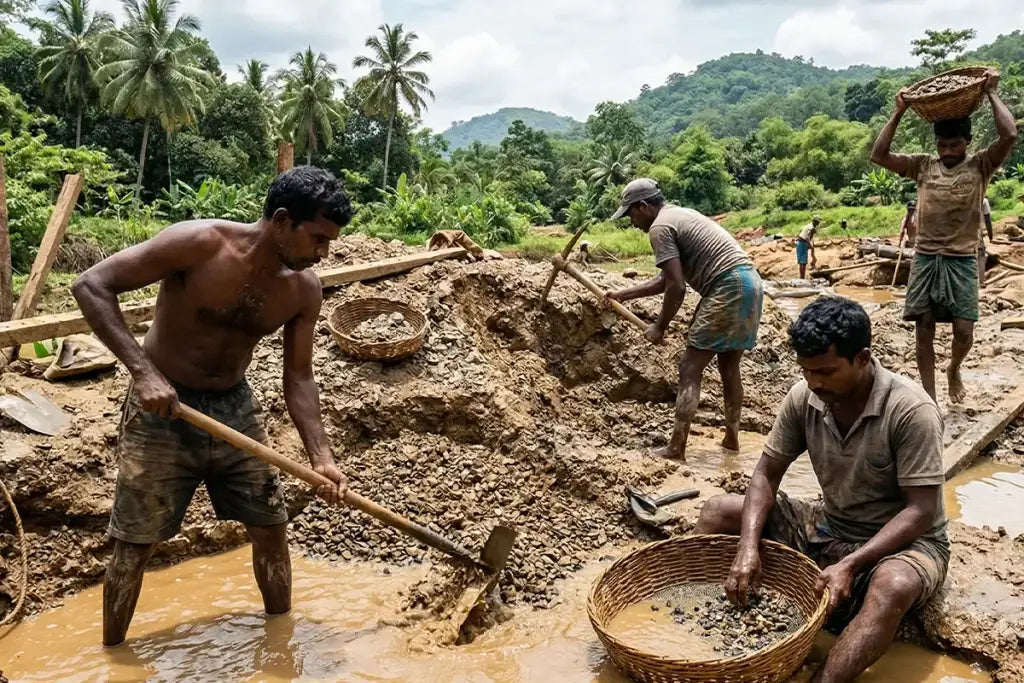
Ratnapura ("the city of gems" in Sinhalese) remains the historic centre of alluvial mining. Rivers erode the gneissic rock and carry crystals into river sediments. Miners dig shallow pits and sift through the sediment, an artisanal method that has not fundamentally changed since antiquity.
Alluvial sapphire mines in Ratnapura, Sri Lanka
The typical colour of Ceylon sapphires is cornflower blue: a light to medium blue of exceptional transparency and clarity. Less intense than Kashmir, yet more luminous and crystalline. Inclusions are rare and delicate in the finest qualities.
Sri Lanka also produces pink sapphires, alexandrites, spinels, and above all: the finest high-grade padparadscha. It is the only origin capable of producing padparadscha certifiable to the most stringent standards.
Lady Diana's ring, today worn by Kate Middleton: an oval Sapphire from Ceylon, approximately 12 carats, set by Garrard in 1981. Reference price for fine Ceylon quality: $1,200 to $6,000/ct depending on saturation, cut, and certification.
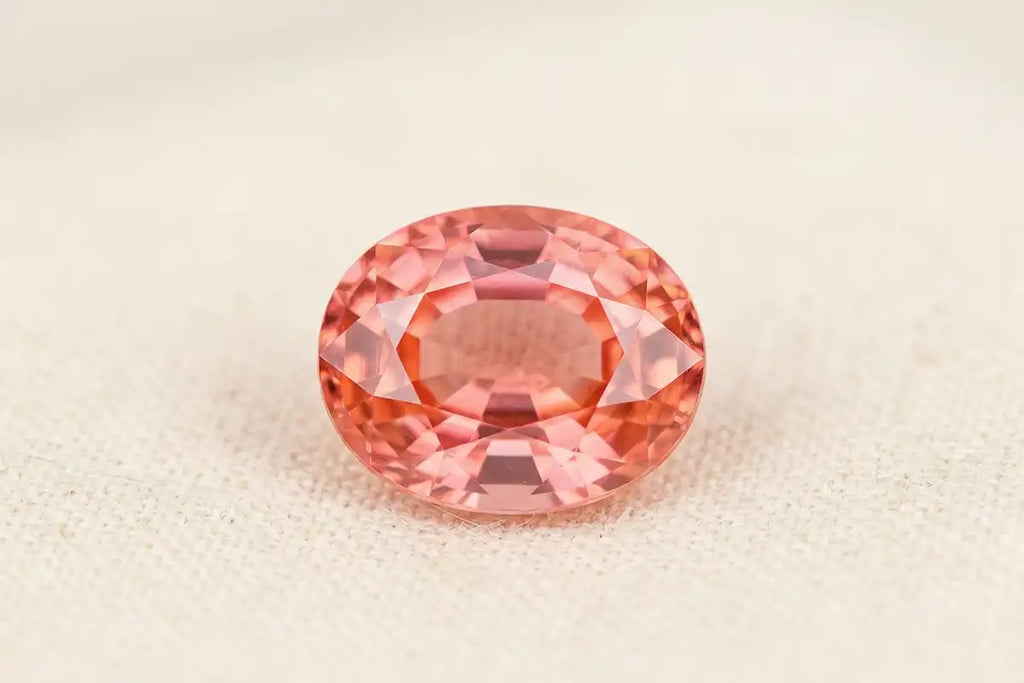
Natural padparadscha sapphire from Sri Lanka, in a pink-orange hue
Padma means "lotus" in Sanskrit, raga means "colour": the colour of the Ceylon lotus. The padparadscha is a Sapphire whose hue strikes a perfect balance between pink and orange, in pastel to medium tones. Not too pink (which would make it a pink sapphire), and not too orange (which would make it an orange sapphire).
This simple definition is, in reality, one of the most debated in gemology. The four major laboratories (GIA, Gübelin, SSEF, GRS) define the boundaries of the padparadscha colour in slightly different ways. The SSEF (Basel) is the world reference for padparadscha certification: their definition is the strictest and most widely respected.
Rarity is extreme: only 1 to 2% of Sri Lankan Sapphires meet the criteria for certifiable padparadscha quality. True Ceylon padparadscha certified by the SSEF are among the most coveted coloured stones on the market. Reference prices: $6,000 to $18,000+/ct for fine certified stones. Beyond 3 carats, certain specimens have exceeded $60,000/ct at auction.
Madagascar also produces padparadscha, often more accessible in price, though the finest pieces remain those of Sri Lankan origin.
The Ilakaka deposit (southern Madagascar), discovered around 1998, sparked a veritable Sapphire rush that transformed the global market within just a few years. The diversity of the host rocks yields an exceptionally wide range of colours: blue in every shade, pink, orange, padparadscha, and leuco-sapphire (white).
Madagascar is today the primary source of commercial padparadscha. Top-tier certifiable stones still come from Sri Lanka, but the majority of global volume originates from Madagascar. For blue sapphires, quality varies considerably; the expertise of an experienced gemologist is essential. A well-selected Madagascar stone can offer excellent fine jewellery quality.
The value for money is the key advantage. More accessible than Ceylon or Kashmir at comparable quality, Madagascar sapphires are an excellent option for projects where the beauty of the stone takes precedence over the prestige of origin.
6. Burma (Myanmar): prestige surrounded by controversy
The Mogok valley is celebrated for its "pigeon's blood" rubies, as well as for "Royal Blue" sapphires of exceptional intensity. Burmese blue is deep and rich, highly saturated: distinct from Kashmir (less "velvety," more "electric").
Since the military coup of February 2021, the landscape has shifted. Most major jewellery houses and reputable dealers have ceased sourcing Burmese stones (EU, US, and UK sanctions in response to human rights violations). The supply chain remains largely opaque.
Our collections do not include sapphires from Burma. This has been a clear position of the house since 2021. Gübelin and SSEF certificates can confirm Burmese origin, but the ethical question surrounding the supply chain remains unresolved.
7. Thailand: the global centre for trading and gem treatment
Chanthaburi (a province east of Bangkok) has been the global centre for colour stone heat treatment since the 1970s. 80% of the world's sapphires pass through its workshops to be heated, selected, and sorted. It is the world market's primary logistical and processing hub.
Local Thai sapphires tend toward a dark blue to blue-black colour (due to high iron content), less sought-after than Ceylon or Kashmir for fine jewellery. Yet Thailand excels in selection and treatment: stones leaving its workshops are sorted with a level of professional rigour recognised worldwide.
Our Mayuri sapphires are, as standard, selected in Thailand: heat-treated (simple thermal treatment), with no beryllium diffusion. Our gemologist partners verify each batch prior to sourcing. For bespoke projects requiring a specific origin (Ceylon, Madagascar), please contact us.
18K yellow gold necklaces set with blue sapphires, worn, Mayuri collection
8. Montana (USA): teal Sapphires in alternative fine jewellery
The Yogo Gulch (Montana) deposit, discovered in 1895 by gold prospectors, is the only primary deposit (non-alluvial) in the United States. Its colour is unique: a slightly silvery blue-green-grey (teal), produced by the site's specific mineralogical composition.
A notable distinction: most Yogo Gulch Sapphires do not respond well to heat treatment. Their colour shifts to grey under heat. They are therefore naturally unheated, which is a highly sought-after quality. This is one of the rare origins where unheated is not a premium, but the standard.
Highly prized in alternative and eco-conscious jewellery circles (US origin, high traceability), Montana Sapphire is priced between $600 and $2,400/ct. Other Montana deposits (Missouri River, Rock Creek) produce a wider range of colours: blue, pink, and bicolour.
9. How to verify the origin of your Sapphire
A laboratory certificate is the only reliable method. The naked eye is not sufficient, even for an expert gemologist. The three leading laboratories are:
Gübelin Gem Lab (Lucerne): the absolute reference for Kashmir Sapphires, recognised by the world's leading auction houses.
SSEF (Basel): the reference for padparadscha and high-end Sapphires, with the most stringent definitions.
GRS (Switzerland/Thailand): the reference for "Royal Blue" designations and the qualification of treatments.
The certificate indicates the probable origin, the type of treatment (heated or unheated, beryllium diffusion or not), the colour according to the laboratory's standards, and the characteristics of the inclusions.
A practical recommendation: origin certification is essential for any piece above $6,000, and for Kashmir stones from $2,400. For our bespoke orders featuring a specific origin, we provide or assist in obtaining the appropriate certification.
Frequently asked questions
How can I tell where my Sapphire comes from?
Only a certificate issued by a recognised gemmological laboratory (Gübelin, SSEF, GRS) can determine origin with certainty. A seller may indicate a probable origin, but without a certificate this information cannot be verified. For Sapphires of significant value (above a few thousand dollars), origin certification is essential.
Are Kashmir Sapphires still being mined?
Practically none. The main Sumjam deposit was intensively mined between approximately 1879 and 1887. Extraction attempts were made during the twentieth century, but without any commercially significant output. Kashmir Sapphires on the market today are almost exclusively antique stones that circulate through auctions and the collector trade.
What is the difference in colour between a Ceylon Sapphire and a Kashmir Sapphire?
The Kashmir Sapphire displays an intense, slightly violet-tinged blue with a velvety effect caused by fine rutile inclusions that diffuse light evenly. The Ceylon Sapphire typically shows a lighter blue (cornflower blue), highly transparent and clear. Both are exceptional, yet distinctly beautiful in their own way: Kashmir is deeper and more mysterious, while Ceylon is brighter and more crystalline.
Which is the better choice, a Ceylon or a Madagascar Sapphire?
It depends on the budget and the project. A beautiful certified Ceylon Sapphire (cornflower blue, high clarity) will generally carry greater value and prestige. But a well-selected Madagascar Sapphire of excellent quality can offer comparable beauty for everyday fine jewellery at a more accessible price. Colour and individual stone quality always take precedence over origin alone.
Are Thai Sapphires of lesser quality?
Local Thai sapphires tend to be dark blue to blue-black, and are generally less sought-after than Kashmir or Ceylon stones for haute joaillerie. Thailand is, above all, the global hub for sapphire trading and heat treatment: the vast majority of sapphires in the world, regardless of their origin, pass through its workshops. Our Mayuri sapphires are selected in Thailand but may come from various origins depending on supply.
Does an origin certificate guarantee the quality of a Sapphire?
No. A certificate confirms provenance and describes any treatments, but it does not guarantee beauty or visual quality. A prestigious origin cannot compensate for a poor colour or visible inclusions. The quality of a Sapphire remains a combined assessment of colour, clarity, cut, and origin.
Are Montana Sapphires naturally untreated?
In the vast majority of cases, yes, for sapphires from Yogo Gulch: their mineralogical composition makes heat treatment ineffective (the colour turns grey). They are therefore sold almost exclusively in their natural, untreated state. Sapphires from other Montana deposits (Rock Creek, Missouri River) can be treated.