The pink sapphire engagement ring: a meaningful alternative to diamond, with expert guidance on quality and selection.
Written by Déborah Baid, Founder · Mayuri ParisReading 11 min9 chapters
What the maison says
What to remember
The diamond solitaire has long been the only answer to the question of an engagement ring. Today, couples are looking for a ring that reflects who they are: colourful, personal, rare. The pink Sapphire answers exactly that expectation.
Romantically pink without being extravagant, it is also practical: with a hardness of 9 on the Mohs scale, it withstands daily wear as well as a diamond, far better than an Emerald or tanzanite. A pink Sapphire engagement ring is not simply a romantic choice; it is a enduring one.
The pink Sapphire belongs to the great corundum family, alongside blue Sapphire, yellow Sapphire, and padparadscha. To discover all the colours within this family, our complete guide to coloured sapphires offers a comprehensive overview. This guide focuses on one specific purpose: the engagement ring, its merits, its nuances, its origins, and the choices that make all the difference.
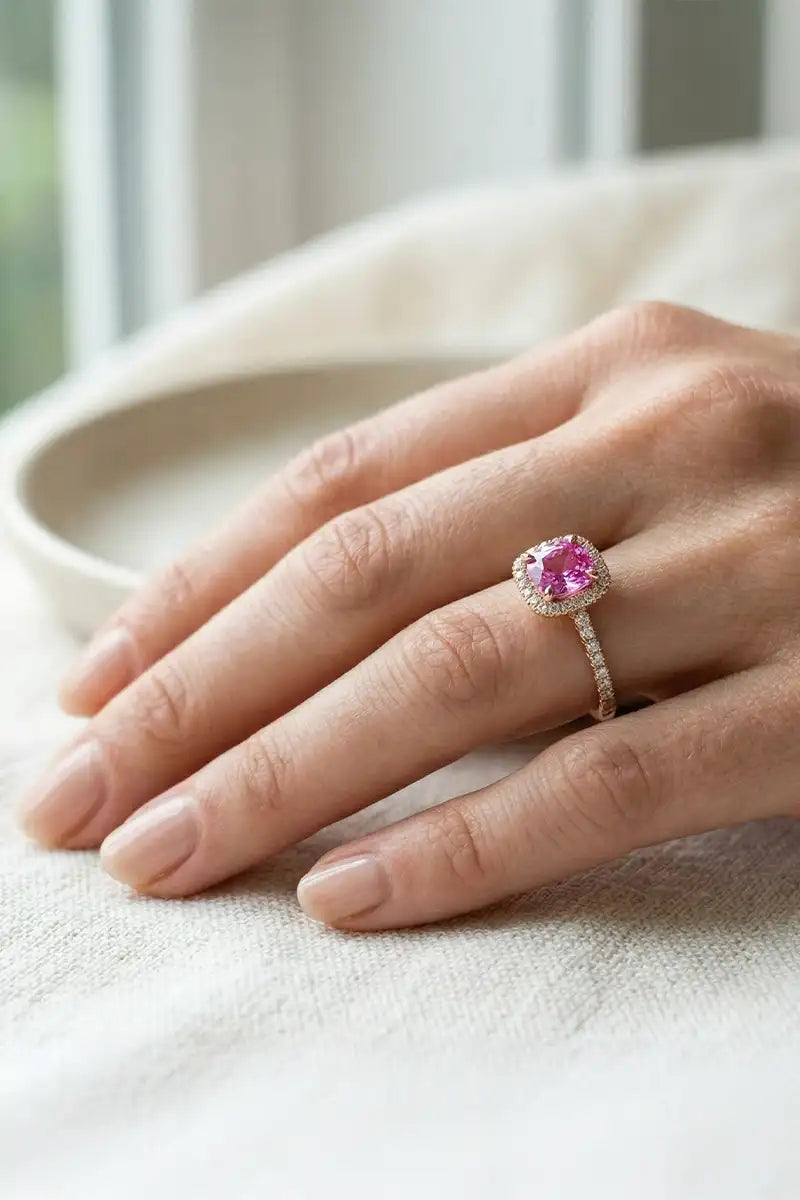
Pink Sapphire and 18K yellow gold engagement ring, worn on the hand, close-up of the claw setting
1. Why choose a pink sapphire for an engagement ring?
Since 2015, international jewellers have observed a confirmed trend: requests for coloured stone engagement rings have grown significantly. Pink Sapphire leads this wave, alongside Emerald and blue Sapphire. This is not a passing trend; it reflects a deeper shift in the way couples think about their jewellery.
The pink of a Sapphire carries a particular emotion. It is neither garish nor ordinary. It evokes tenderness, the freshness of a feeling, the softness of a commitment. Neither the passionate red of a Ruby, nor the cool white of a diamond: something more intimate, more personal. A choice that speaks for itself, without needing any explanation.
In a market dominated by diamond solitaires, a pink Sapphire engagement ring is immediately different. Memorable. It says something about the person who wears it and the couple who chose it. Contrary to common assumptions, choosing a pink Sapphire is not eccentric; it is simply choosing meaning over convention.
For couples who care about the origins of their purchases, a pink Sapphire with certified provenance (Sri Lanka, Madagascar) represents a compelling alternative to diamonds, whose traceability remains more difficult to document. And with a hardness of 9, it is built to last just as long as a diamond, with absolutely no compromise on durability.
2. Pink sapphire or ruby: where the line is drawn
The question is inevitable, and it deserves a precise answer. Pink Sapphire and Ruby are the same mineral: corundum (Al₂O₃), coloured by chromium ions (Cr³⁺). The difference comes down entirely to chromium concentration. The higher it is, the more the colour shifts toward red, and the more the stone is called a Ruby. The lower it is, the more the hue remains pink: it is a pink Sapphire.
The reference standard is that of the GIA (Gemological Institute of America): "Red must be the dominant hue." If red is the dominant hue, the stone is a Ruby. If pink prevails, it is a pink Sapphire. This boundary is officially acknowledged as subjective by the GIA itself, which uses reference stones to standardise evaluation.
The GRS (Gem Research Swisslab) applies an even more restrictive "ruby" threshold. The same stone may be classified as a Ruby in Tokyo and a pink Sapphire in Paris, depending on local gemological traditions. The commercial impact is considerable: a GRS-certified Ruby is worth several times more than a pink Sapphire of the same size and quality. The boundary is not only aesthetic; it is economic.
In practice, a beautiful raspberry or fuchsia pink sapphire can be absolutely stunning, even if it does not reach the ruby threshold. And it will be significantly more accessible. Our article explores in detail the boundary between ruby and pink sapphire.
Celebrities have played a decisive role in popularising pink sapphire as an engagement stone. Three rings have made a particular mark this decade.
Lady Gaga: in 2019, Christian Carino gave her a 7-carat pink sapphire set in a gold mounting, estimated at around $400,000. The ring is a reference in contemporary fine jewellery. Its intense colour, its scale, and its character make it the perfect example of what pink sapphire can be at its finest. (Source: The Jewellery Editor)
Katy Perry: Orlando Bloom gave her in 2019 a cluster ring in the shape of a flower, with a pink centre stone surrounded by eight diamonds. The exact nature of the stone (ruby or pink sapphire?) has not been officially confirmed by the jewellery house. This uncertainty speaks to the fluidity of that boundary. The ring remains one of the most photographed of the decade. (Source: Hello Magazine)
Princess Eugenie: her engagement ring features a padparadscha, an extremely rare pink-orange variety of corundum, the most coveted form within the pink sapphire family. It is technically a direct cousin of the pink sapphire, distinguished by its characteristic orange undertone.
4. How to assess the quality of a pink sapphire
Colour above all
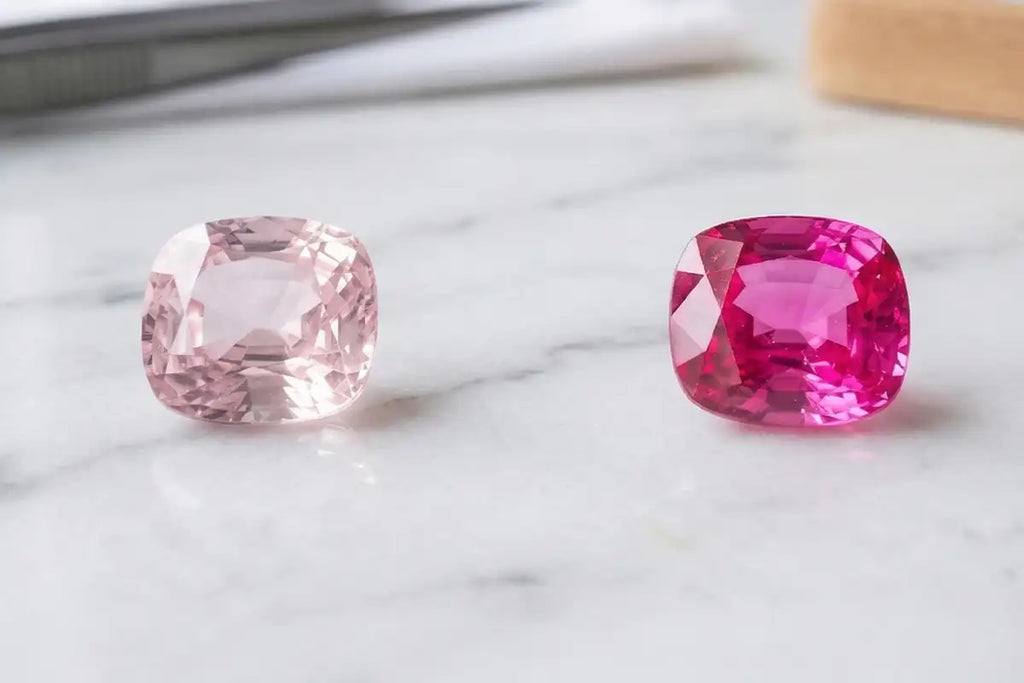
Comparison between a pale pink sapphire and a deep pink sapphire, set on white marble, showcasing the full range of hues
Colour is by far the most important criterion. The ideal pink sits between luminous light rose and intense fuchsia, with high saturation and vivid brilliance: no grey, no brown in the undertones. These unwanted modifiers, known as "extinction," considerably diminish the appeal of the stone, even when the overall hue is beautiful.
"Vivid pink" is the rarest and most prized: it is the colour that makes the stone radiate even under the artificial lighting of a restaurant. The industry distinguishes between "pastel pink" (soft and delicate), "medium pink," "vivid pink" (intense fuchsia), and "hot pink." Each level corresponds to a distinct market reality and a different visual experience.
Clarity
Pink sapphire tolerates inclusions more readily than diamond. Minor inclusions invisible to the naked eye are generally acceptable. Surface-reaching inclusions, veils that impair transparency, or fractures running through the stone should be avoided. Unlike ruby, silk inclusions (rutile needles) are rare in pink sapphire; when present and well-oriented, they can create an asterism effect, a six-pointed star visible under direct light.
Treatments
Thermal heating (heat treatment) applies to the vast majority of pink sapphires on the market. It improves colour and clarity in a permanent, stable manner. This is an age-old process, universally accepted by gemological laboratories, noted as "H" on certificates. It does not disqualify a beautiful stone.
A certified "no heat" pink sapphire belongs to an altogether different category. A stone with documented absence of thermal treatment is worth 30 to 100% more than a heated equivalent, not because it is necessarily more beautiful to the naked eye, but because it is rarer and represents the earth's original colour. Beryllium diffusion, a treatment that intensifies the pink-orange hue, must always be disclosed and will appear on the certificate.
Just as with yellow sapphire and its Vedic traditions, certification is the guarantee of an informed purchase.
Certification
For any solitaire stone above one carat, a GIA, GRS, or Gübelin certificate is essential. It guarantees colour, treatments, and origin: the only reliable protection against an undisclosed treated pink sapphire or an overstated provenance.
5. Origins that make all the difference
Origin
Characteristics
Price Impact
Sri Lanka (Ceylon)
Pale to vivid pink hues, exceptional clarity, mines active since Antiquity. The world's historic benchmark
Historic premium, the market reference
Madagascar
Intense pink tones very close to Ceylon, comparable quality, mines in operation since the 1990s, documented ethical sourcing
20-30% less expensive at equivalent quality, outstanding value for money
Myanmar (Burma)
Intense pink Sapphires, sometimes on the threshold of Ruby according to GIA/GRS
Premium if certified, geographic rarity
Thailand / Cambodia
Darker tones, often heat-treated
Standard commercial quality
Ceylon remains the absolute benchmark for collectors and investors. Madagascar, on the other hand, offers a remarkable balance: comparable quality, more accessible pricing, and a verifiable ethical sourcing that appeals to an increasingly conscientious generation of couples.
Beyond optical quality, origin is an argument for certification and resale value. A certified "no heat" pink sapphire from Ceylon is a collector's piece: its traceability and rarity lend it enduring value. A pink sapphire of uncertain provenance, without a certificate, will always remain a jewel without a story.
6. The price of pink sapphire in an engagement ring
Quality
Characteristics
Price/ct
Commercial quality
Pale pink, treated (heat), origin not certified
$120–$600/ct
Jewellery quality
Medium pink, certified, heat, GIA
$600–$2,400/ct
Fine jewellery quality
Vivid to vivid pink, no heat, GIA or GRS
$2,400–$14,000/ct
Exceptional / record
Hot pink, no heat, large size, premium origin
> $18,000/ct
The comparison with other stones is illuminating. A fine jewellery-grade pink sapphire costs three to five times less than a comparable Ruby, and five to eight times less than a D/IF white diamond of the same weight. For a fine jewellery engagement ring, expect to invest between $3,000 and $6,000 for a certified pink sapphire of 0.8 to 1.2 carats, set in 18K yellow gold.
Pink sapphire prices have risen by approximately 18% between 2023 and 2025, driven by demand from the luxury market and the growing scarcity of large no-heat stones. The pink sapphire is one of the rare precious stones that offers, today, this balance between quality, uniqueness, and relative accessibility.
7. Hardness and durability: a stone for a lifetime
The Mohs scale places the pink sapphire at 9/10, just below the Diamond. In everyday life, this means concretely that only a diamond or another stone of hardness 9 or 10 can scratch a pink sapphire. Stainless steel (6.5), glass (5.5), concrete (5): none will leave a mark.
The comparison with other popular engagement stones is telling: Diamond (10), Pink Sapphire and Ruby (9), Emerald (7.5), Tanzanite (6.5), Opal (6). An Emerald engagement ring requires far greater care in daily wear than a pink sapphire ring. The pink sapphire is more resilient, less prone to chipping, and does not lose its brilliance over time.
For the setting, a claw setting (four or six prongs) or a bezel setting in 18K gold protects the stone beautifully while enhancing its colour. Care is straightforward: lukewarm water, mild soap, and a soft brush once a week. Pink sapphire tolerates ultrasonic cleaning well, except in the very rare case of glass filling, which can be verified on the certificate.
8. Who is a pink sapphire engagement ring right for?
There is a woman who recognises herself in the pink sapphire without our needing to describe her at length. She is not seeking to impress; she is seeking to be known. She may carry a great deal of pink in her life, in her wardrobe, in her interiors, in her cultural references, and the ring becomes a quiet coherence rather than an arbitrary choice. Or, on the contrary, she has nothing particularly "pink" about her, yet she is drawn to this colour precisely because it says something different.
She thinks of her jewels as an extension of herself, not as a social code to observe. She knows what she wants and she is able to own it in a boardroom as much as at a wedding dinner. The pink sapphire is a choice that endures because it owes nothing to trends: it owes everything to personality.
The understated solitaire: a single pink sapphire, claw-set on a slender 18K gold band. Everything rests on the stone. Timeless, elegant, and absolutely coherent. Ideal for women who value refinement and let colour speak for itself.
The halo or diamond surround: a circle of small white diamonds around the pink sapphire amplifies the brilliance of the central stone. The white-and-pink contrast is spectacular, and the the apparent size of the ring increases significantly. Well suited to slender fingers, it has a strong presence and the character of a piece that turns heads.
The diamond pavé: a band fully set with diamonds, with a pink sapphire at the centre. A maximalist, luxurious effect, for those who love brilliance and wear their jewellery as a statement.
The floral cluster: a pink sapphire surrounded by diamonds or other stones in a floral or organic composition. Bohemian, one of a kind, and very much in the spotlight since 2020. It is the style of Katy Perry's ring, and it suits a creative, independent personality perfectly.
For the metal: 18K rose gold creates a natural harmony, soft and feminine. 18K white gold offers a modern contrast that enhances pale pink and lilac tones. 18K yellow gold brings out fuchsias and deep pinks in a warm, bold contrast.
9. Your bespoke pink sapphire engagement ring, made to order at Mayuri
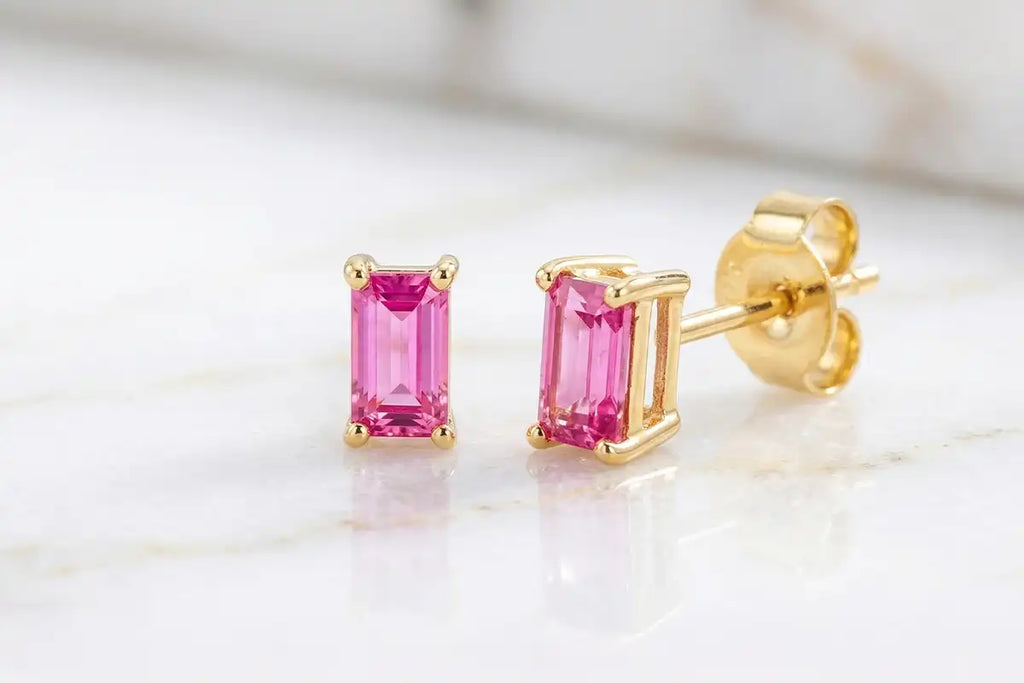
Pink sapphire baguette cut Earrings in 18K yellow gold by Mayuri, bespoke fine jewellery
At Mayuri, we do not offer pink sapphires as part of our permanent collection. This is a deliberate choice. Every pink sapphire is unique in its hue, its origin, its character: it would make no sense to present these stones as standardised references. This is why we work exclusively on a bespoke basis for pink sapphire engagement rings.
Our approach is straightforward: you describe the hue that speaks to you (romantic pale pink, vibrant fuchsia, or a warm rose somewhere in between), the setting style you have in mind (solitaire, halo, pavé, cluster), and the metal. Our gemologists then source the stone that perfectly matches your vision, from our certified suppliers.
Our pink sapphires are GIA or GRS certified for stones over one carat. Treatments are always disclosed. We can source specific origins to suit your preferences: Ceylon no-heat for lovers of exceptional stones, and Madagascar for an excellent value-to-quality ratio and documented ethical sourcing.
At Mayuri, we deeply believe in going beyond the most common stones on the market. Pink, yellow, orange, and violet sapphires make it possible to create a piece of jewellery that is truly one of a kind, with no compromise on gemological quality. Please do not hesitate to contact us to source the hue that reflects your personality; our team will be delighted to guide you.
Yes. With a hardness of 9/10 on the Mohs scale, the pink sapphire is the second hardest mineral after the diamond. It holds up beautifully to daily wear, without scratching or losing its brilliance. It is a stone built to last for decades.
What is the difference between a pink sapphire and a ruby?
They belong to the same mineralogical family (corundum), coloured by chromium. When red is the dominant tone, it is a Ruby (GIA criterion). When pink dominates, it is a pink sapphire. The boundary is widely acknowledged as subjective among gemologists, with differences between Western and Asian traditions, and a direct impact on price.
How much does a pink sapphire cost for an engagement ring?
Between $120 and $14,000 per carat, depending on quality, origin, and treatments. For a fine jewellery engagement ring (0.8 to 1.2 ct, certified, 18K gold), expect to invest between $3,000 and $6,000 depending on the quality desired. Our gemologists can guide you according to your budget.
Is a GIA certificate necessary for a pink sapphire?
For a solitaire stone from one carat onwards, yes. A GIA or GRS certificate guarantees the colour, any treatments (heat/no heat) and the origin. It is the only reliable protection against an undisclosed treated pink sapphire.
Which celebrities wear a pink sapphire ring?
Lady Gaga (7 ct, estimated at around $450,000), Katy Perry (a floral cluster in pink, with the nature of the stone not officially confirmed), and Princess Eugenie with a padparadscha: the pink-orange variety that is the rarest form of colour corundum.
Pink sapphire or Ruby: which to choose for an engagement ring?
If you are drawn to deep red and the symbolism of passion, choose the Ruby. If you prefer a romantic, softer pink with a more accessible budget, the pink Sapphire is the ideal choice. Both are corundum stones with a hardness of 9/10, equally resilient for everyday wear.
Where do the finest pink sapphires come from?
Sri Lanka (Ceylon) is the historic benchmark: exceptional clarity, a gemological reputation established since Antiquity. Madagascar produces stones of very comparable quality, 20 to 30% less expensive at equivalent quality, with documented ethical sourcing. Burma produces rare pink sapphires, sometimes on the threshold of Ruby according to GIA criteria.
Does a pink sapphire fade over time?
No. The colour of a pink Sapphire is stable: it does not shift in different lighting, does not change with ambient temperature, and resists everyday products. It is one of the most stable stones in fine jewellery. A pink Sapphire ring worn for twenty years will have exactly the same colour as on the very first day.