Natural vs. treated black diamond: how to tell the difference?
How to tell a natural black diamond from a treated one: gemological comparison, carbonado, and GIA/IGI certifications.
Written by Johan Nel, Jewellery designer & goldsmith · trained in gemology · Mayuri ParisReading 10 min7 chapters
What the maison says
What to remember
Your jeweller is offering you a "black diamond" piece. You may find yourself wondering: is it truly a diamond? Is it natural? Has it been altered? These are entirely legitimate questions, and the answers will shape how you shop, what budget to plan for, and how to care for your jewellery.
In this article, we distinguish between the three types of black diamonds you may encounter on the market: the naturally occurring, the carbonado, and the treated. We explain how to identify each one, what certifications reveal, and where Mayuri stands.
For a complete introduction to black diamonds, consult our comprehensive guide.
The three types of black diamonds: natural with inclusions, carbonado, and treated; a gemological comparison
1. Why the majority of black diamonds are treated
The naturally black diamond is rare. Its geographical distribution is limited (Brazil, Central Africa, Siberia), its geological formation is unpredictable, and its cutting process is often delicate due to inclusions that can create potential fractures. The global production of gem-quality natural black diamonds represents a tiny fraction of total diamond output.
A practical alternative has been well established since the 1990s: taking a commercial-grade white diamond (I2–I3 inclusions, M to Z colour), abundant and inexpensive in its rough state, and rendering it black through heat treatment. The result is a black diamond with a deep, uniform colour and the same physical properties as a white diamond (hardness 10), at a price significantly lower than a certified natural stone.
This process has become the industry standard. Today, more than 90% of "black diamond" jewellery sold on the market uses treated diamonds, as confirmed by the GIA and the IGS. This is not a form of deception: the treatment is stable and permanent, and the stone remains a genuine diamond (pure carbon, hardness 10). What a jeweller must do, and what Mayuri does, is disclose this clearly.
2. The treatment process: irradiation and HPHT
Two processes dominate the market for darkening a white diamond.
Irradiation and annealing (the most common)
The white diamond is exposed to radiation (gamma rays, electrons, or neutrons) in a particle accelerator. The irradiation creates defects in the crystal structure that alter the absorption of visible light: the stone shifts to deep green, then blue-black, then intense black depending on the dose and type of radiation. A subsequent high-temperature thermal annealing process permanently stabilises the colour.
The result: a uniform, stable, and permanent black colour. Indistinguishable to the naked eye from a natural stone, even for an experienced gemologist without laboratory instruments.
HPHT (High Pressure High Temperature)
This process replicates the conditions under which diamonds form in the Earth's mantle. It modifies the electronic structure of the white diamond to produce total absorption of visible light. Less common than irradiation for black diamonds, it is primarily used to decolourise brown diamonds, transforming them into colourless or improved near-colourless stones.
What certifications reveal
A GIA report for a treated black diamond carries the mention "Color Origin: Treated (irradiation)". A natural black diamond bears "Color Origin: Natural". The distinction is clearly stated on the certificate. Without a certificate, assume the black diamond is treated: this is the case for the vast majority of jewellery pieces.
Carbonado is not a diamond like any other, and it deserves a section of its own.
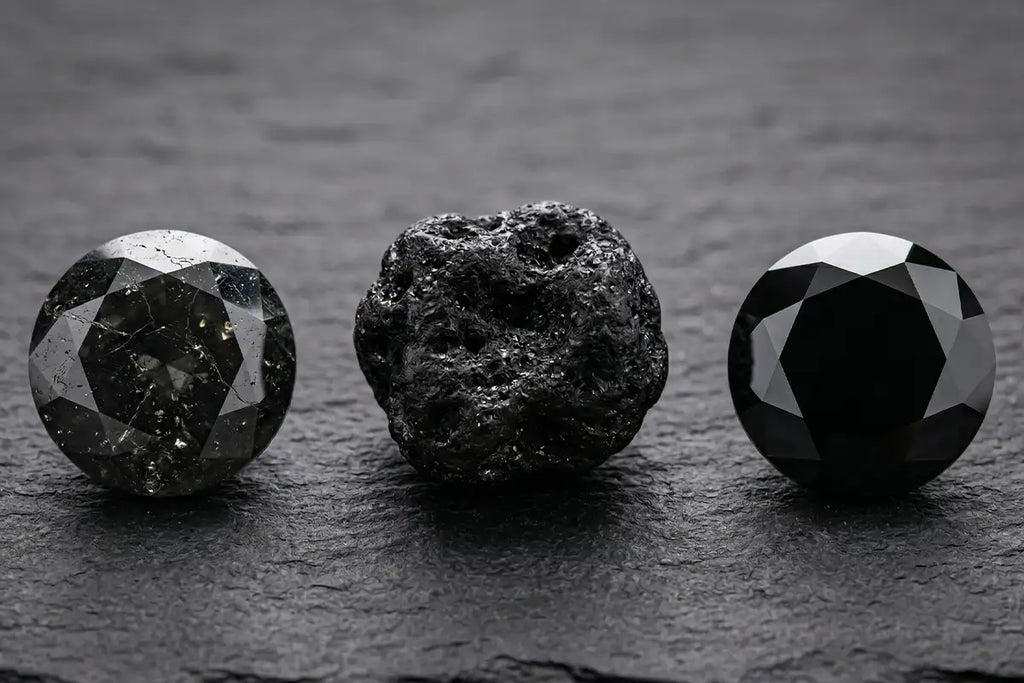
It is a polycrystalline diamond: an aggregate of thousands of carbon microcrystals (graphite, diamond, amorphous carbon) forming an opaque and porous mass. It shares neither the same structure nor the same origins as an ordinary diamond, whether natural or treated.
Strictly limited origins. Carbonado is found in only two places in the world: Brazil (the state of Bahia) and the Central African Republic. Never in the classic kimberlite pipes that produce other diamonds. This restricted geographical distribution, and the fact that both territories were once part of the same continental landmass (Gondwana) before its break-up, lie at the heart of the scientific mystery.
The extraterrestrial theory. The most compelling scientific hypothesis, published by the GIA in *Gems & Gemology* in the summer of 2017, suggests that carbonado formed in a supernova explosion approximately 3.8 billion years ago, well before the birth of our Sun, and arrived on Earth as a meteorite around 2.3 billion years ago. This theory is supported by the presence of hydrogen in carbonado (absent from terrestrial diamonds) and by its unique isotopic composition.
Appearance and uses. Carbonado is opaque, irregular and often porous. Its structure makes it difficult to cut into a faceted gemstone: the rare jewellery pieces featuring carbonado are truly exceptional creations. It is primarily used in industry as an abrasive.
What to know if you are looking for a carbonado. Request a certificate specifying "polycrystalline diamond" or "carbonado". Standard GIA and IGI certificates do not generally identify carbonado as such: they certify only whether the colour is natural or treated. A report from the GIA research department or a specialist laboratory is required for carbonado certification.
4. The natural black diamond: how to identify it
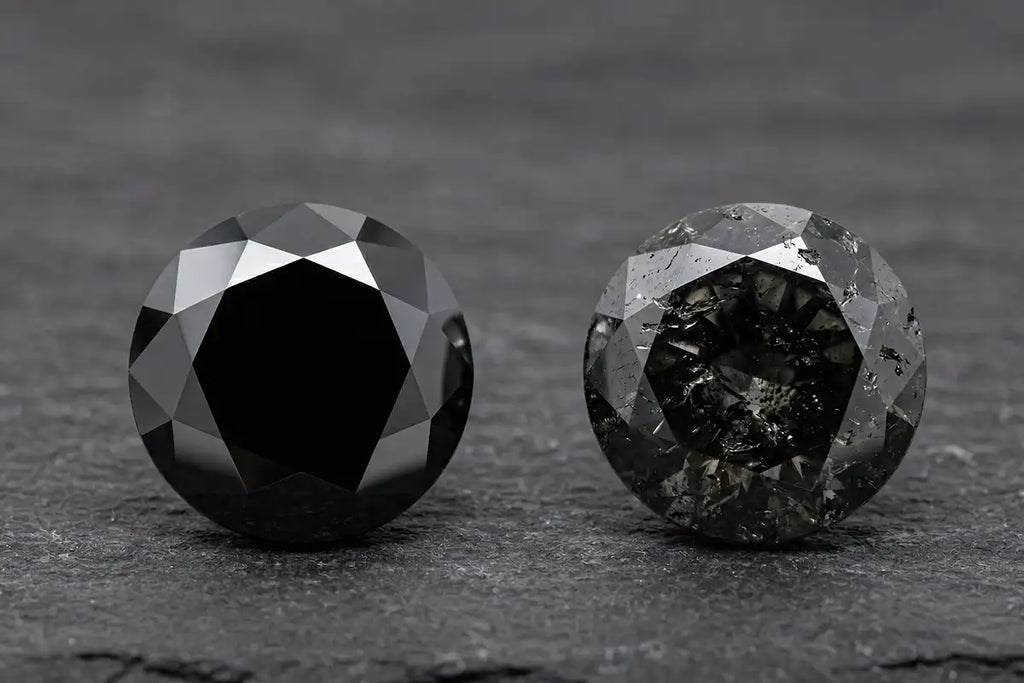
Gemological comparison between a treated black diamond and a natural black diamond with inclusions
The ordinary natural black diamond is a monocrystalline diamond (like a white diamond), whose black colour comes from massive inclusions of graphite, pyrite or magnetite formed naturally during crystallisation.
What sets it apart from the treated stone
To the naked eye, the difference is difficult to perceive. It is laboratory instruments that allow a definitive conclusion. A few visual indicators do exist, however:
Non-uniform colour: a natural black diamond may show slightly grey areas, subtle variations in hue, or visible internal textures. A treated stone typically displays a more "perfect" black, unnaturally uniform.
Inclusions visible under a loupe (x10): individual inclusions, areas of variable colour, and isolated graphite or pyrite crystals are all indicators of a natural stone. A treated diamond does not exhibit this type of residual inclusion.
Light test: under transmitted light (by holding the stone up to a light source), a treated black diamond may allow a faint amount of light to pass through its less dense areas. A natural stone absorbs it entirely.
The definitive test. FTIR spectrometry (Fourier-transform infrared) is the only absolute gemological test available. Not accessible to the general public, it is offered by GIA, IGI, SSEF and Gübelin. In store, ask for the certificate: a reputable seller should be able to provide it, or at minimum clearly state whether the stone has been treated.
Two gemological laboratories cover the vast majority of the jewellery market:
GIA (Gemological Institute of America)
The global benchmark. For black diamonds, the GIA issues a colour report specifying: carat weight, shape and dimensions, cut, and most importantly the notation "Color Origin: Natural" or "Color Origin: Treated (irradiation)". This report is the absolute reference document for understanding exactly what you are purchasing.
IGI (International Gemological Institute)
Also recognised on the international market, and more accessible for mid-range stones. Uses the same colour origin terminology as the GIA.
What the certificate does not tell you. Standard GIA and IGI reports do not distinguish between carbonado and ordinary natural black diamond: they certify only whether the colour is natural or treated. A specific report is required for "carbonado" certification.
In the absence of a certificate. Assume the black diamond is treated. This is not an issue in itself, provided the price reflects it. However, never pay the price of a certified natural stone without certification. The price difference ranges from 5 to 15 times: a mistake that can amount to thousands of dollars.
6. What this means in practice
For everyday wear. Almost nothing. Treated black diamonds and natural black diamonds share the same hardness (10) and the same visual appearance, as well as the same care requirements. There is no perceptible difference to the naked eye, even for a gemologist in a boutique.
For price. The gap is very significant. A treated black diamond of jewellery quality (precise cut, uniform colour) sits in the low to mid range per carat. A GIA-certified "naturally colored" black diamond is 5 to 15 times more expensive, depending on weight and quality.
For resale. A treated black diamond holds no resale value on the second-hand market, as is the case with the vast majority of mid-range jewellery pieces. A GIA-certified natural stone can retain value on the specialist market, particularly for stones weighing more than 2 carats.
For personal symbolism. Some clients place great importance on the fact that their stone is "natural", unaltered by human hands. This is an entirely valid emotional choice, not a gemological question.
7. Mayuri's approach: transparency and sourcing available on request
Mayuri uses treated black diamonds across its collection. This is a deliberate choice: it allows us to offer fine jewellery pieces in 18K gold at an accessible price-to-quality ratio, with a visual beauty identical to that of a natural stone. We have never concealed this; transparency is central to our approach.
For lovers of natural stones, Mayuri sources natural black diamonds on request. Each stone is unique: its inclusions, its inner texture, its geological history. Some feature striking grey zones, isolated graphite crystals that resemble a miniature starry sky. No two are alike.
A client contacted us for a custom pendant featuring a natural black diamond. We presented a selection of stones with visible inclusions, some quite pronounced. His words: "I want this one, these inclusions, this is its story. Perhaps this material literally came from the stars." These are exactly the kinds of conversations we cherish.
For this type of project, contact us directly for personalised sourcing.
Yes. It is pure carbon (hardness 10), a true diamond. Only the colour has been modified through heat treatment. It is not glass, onyx, or an imitation.
How do I request a certificate for my jewellery?
At a jeweller, ask for the GIA or IGI report for the stone. If the piece is not individually certified (which is common for accessible pieces), the seller must at minimum indicate whether the stone is treated.
Can a black diamond be certified after purchase?
Yes. The stone must be unmounted (or sent mounted through your jeweller). A GIA or IGI report can be obtained in 4 to 8 weeks depending on the laboratory. Allow approximately $100 to $250 depending on the size of the stone.
Is the treatment reversible?
No. Irradiation and annealing permanently alter the crystal structure. The black colour is permanent under normal conditions of wear.