GemologyThe Mayuri Journal27 March 2026
Enriched on 19 August 2026
Diamond
Diamond Guide: everything you need to know before buying a diamond jewel
The complete diamond guide: formation, the 4Cs, origins, certifications, and expert advice for choosing well.
Written by Déborah Baid, Founder · Mayuri ParisReading 18 min12 chapters
What the maison says
What to remember
Diamond was born one to three billion years ago, 150 kilometres beneath the Earth's surface, under a pressure of 5 gigapascals and a heat of 1,300 degrees. Volcanic eruptions of rare violence propelled it toward the surface. And it is this stone, extracted from a mine, cut into 58 facets according to millimetre-precise geometry, that one slips onto a finger on the day of a marriage proposal. At Mayuri, Diamond is a foundational stone: we offer it in four versions, classic white, sculptural black, singular champagne and exceedingly rare green, all selected at G/VVS quality for maximum brilliance in everyday wear. This guide covers Diamond from every angle: chemistry and formation, the 4Cs system, natural versus laboratory, ethical sourcing, colour variants, symbolism and care.
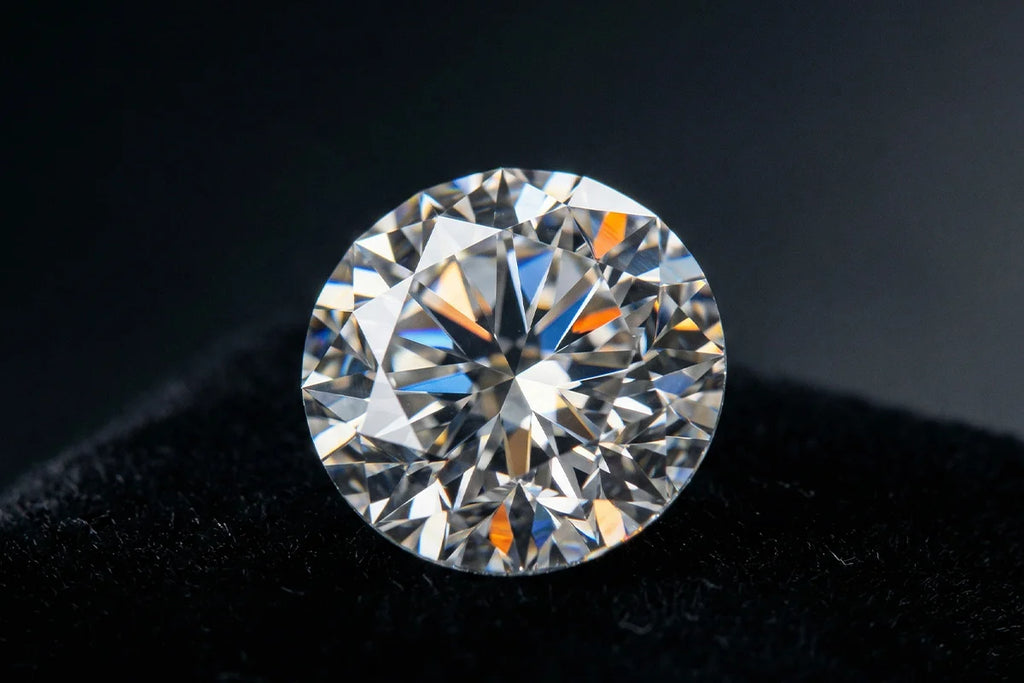
Close-up of a brilliant cut natural diamond, light playing across its facets
1. What is a diamond? Chemistry and formation
Diamond is pure carbon arranged in a cubic crystalline structure: each carbon atom is bonded to four others in a tetrahedral arrangement that forms the densest lattice found in nature. It is this atomic organisation that gives it a hardness of 10 out of 10 on the Mohs scale, making it the only natural mineral that no other substance can scratch. Its formation is one of geology's most extraordinary stories: one to three billion years ago, carbon crystallised under a pressure of 5 gigapascals at 1,300 degrees Celsius, at depths of between 150 and 200 kilometres. Volcanic eruptions known as kimberlite pipes propelled these crystals toward the surface at supersonic speeds, preserving them from the decompression that would have transformed them into graphite. Compared to other precious stones, Diamond is unique: Ruby, Sapphire and Emerald are complex oxides or silicates. Diamond is the only one composed of a single element. This chemical purity explains its exceptional hardness, its refractive index of 2.417 (the highest of any natural stone) and its spectacular dispersion of light, that rainbow visible within the facets of a well-cut Diamond. A counterintuitive fact: graphite, the ordinary carbon found in pencil leads, is chemically identical to Diamond. Only the arrangement of atoms differs. Sources: GIA Diamond Formation, Wikipedia, "Diamond"
2. The 4Cs of diamonds: how to evaluate quality
The 4Cs system was developed in the 1950s by the GIA (Gemological Institute of America) to standardise the evaluation of diamonds on a global scale. Before it existed, every jeweller used their own criteria. Today, the 4Cs are the universal reference for gemologists, insurers and buyers alike. Cut: the most decisive of the 4Cs for brilliance. It refers to the quality of the cutting execution, proportions, symmetry and polish, not the shape. An excellently cut Diamond captures light and returns it directly to the eye. GIA grade: Excellent to Poor. Color: a scale from D (perfectly colourless) to Z (slightly yellow). The G grade, our standard, is near-colourless: the nuance disappears once set in a mounting. Clarity: from FL (no inclusions under 10x magnification) to I3 (inclusions visible to the naked eye). VVS, our standard, means inclusions undetectable even under a 10x loupe. Carat: 1 carat equals 0.2 grams. The price per carat is not linear: a 1-carat Diamond is worth significantly more than two 0.5-carat stones, because larger diamonds are rarer. Price jumps occur at round thresholds (0.50 ct, 1 ct, 1.50 ct, 2 ct).
All our diamonds are selected at G/VVS quality. This is not the absolute pinnacle of the market (D/FL exists for collectors and exceptional pieces), but it represents the optimal balance between perceptible maximum brilliance and genuine value for money. A G Diamond is near-colourless: the slight nuance disappears once set in gold. A VVS Diamond presents no inclusions visible to the naked eye, whether in everyday light or under a boutique spotlight. Why not go as far as D/FL? For a piece worn daily, the difference between D and G is imperceptible even to our gemologists without equipment. This choice allows us to invest where it truly matters: an Excellent cut grade and 18K gold settings, the combination that produces visible brilliance.
A laboratory Diamond is chemically identical to a natural Diamond: the same pure carbon, the same cubic crystalline structure, the same hardness of 10. The difference lies in its origin: formed in a matter of weeks inside an industrial reactor rather than crystallised over billions of years 150 kilometres beneath the Earth. Two processes exist: CVD (Chemical Vapor Deposition) deposits carbon layer by layer in a gaseous environment; HPHT (High Pressure High Temperature) reproduces natural conditions within industrial presses. The central question for the buyer is long-term value. According to the GIA, a laboratory Diamond loses between 70 and 90% of its value upon resale, compared to a much slower depreciation for natural diamonds, whose geological rarity remains constant. Our position: all our jewellery features natural diamonds. We can source lab-grown diamonds on request for bespoke projects. This choice rests on two convictions: long-term intrinsic value and our commitment to responsible, traceable mining.
Botswana is the world's leading producer by value, accounting for approximately 30% of global production (Jwaneng and Orapa mines). South Africa (Venetia mine), Canada (Ekati, Diavik) and Russia complete the picture. The regulatory framework governing the industry is the Kimberley Process (KPCS), established in 2003: its 85 member countries commit to trading only in diamonds certified as originating outside conflict zones, accessible at kimberleyprocess.com. At Mayuri, we go beyond the Kimberley Process: we source through recognised marketplaces (Antwerp, primarily) from suppliers who provide full mine-to-market traceability. We require every batch to be documented, that extraction conditions respect workers' rights, and that environmental practices are independently audited. No conflict diamonds, no opaque sourcing.
The absolute of light. In G/VVS quality and Excellent cut, it captures light from every angle and reflects it back to the wearer's eye, dispersing it into a rainbow. It pairs beautifully with white, yellow or rose gold, complementing every skin tone. The timeless choice, yet never ordinary.
Black Diamond
Opaque, sculptural, a counterpoint to the traditional diamond. Its colour comes from thousands of micro-inclusions that absorb light rather than refract it. It can be natural or treated through irradiation, both stable with everyday wear. Against white gold, it creates a striking contrast. One important note: never use ultrasonic cleaning; hand-wash only with mild soapy water.
Champagne Diamond
Also known as cognac or golden brown, depending on its intensity. Its natural colour comes from nitrogen impurities within the crystal structure: not a flaw, but a personality. Set in 18K yellow gold, it creates a warm, luminous harmony. In rose gold, it plays within the same amber register. The choice for those who embrace a singular piece of jewellery, neither white nor vividly coloured.
Green Diamond
The rarest of our four variants. Its natural green colour is caused by geological irradiation during formation: radioactive particles emitted by surrounding rocks bombarded the crystal over millions of years. The result is a verdant, botanical brilliance unlike any other. For rare fancy colour diamonds (intense green, pink, blue), please contact us directly.
7. April birthstone
The Diamond is the official birthstone for the month of April (AGTA, American Gem Trade Association). For those born under Aries (21 March to 19 April) and Taurus (20 April to 20 May), it embodies clarity, inner strength and unconditional love. In the Vedic tradition, the diamond bears the name of Vajra in Sanskrit: lightning and the indestructible, at once. It is the weapon of Indra, the god of thunder. In Vedic astrology (Jyotish), the Diamond is associated with Shukra, the planet of Venus: love, arts, beauty, and prosperity. It holds a central place in the Navaratna, the necklace of nine sacred stones in the Indian tradition. This dual resonance, the Western tradition of birthstones and the Vedic tradition of the Vajra, makes the Diamond a particularly meaningful stone for Mayuri, a Franco-Indian house.
The Diamond engagement ring owes its contemporary universality to a 1947 advertising campaign ("A Diamond is Forever," De Beers) as much as to centuries of symbolism around eternity. Yet its enduring dominance rests on something more tangible: its hardness of 10 makes it the ideal stone for a ring worn every day for decades. A G/VVS solitaire, Excellent cut, set in 18K white gold or 18K yellow gold, will be worn for fifty years without losing its brilliance (the setting should be checked every two to three years). For couples who wish to step away from tradition without rejecting it entirely: a Black Diamond solitaire for a bold, modern choice, or a champagne diamond for a touch of warmth and individuality.
A hardness of 10 protects the Diamond from everyday scratches, but not from buildup. Skin, moisturisers, and makeup form a thin film that dulls the facets within weeks: a poorly maintained Diamond can lose up to 40% of its visible brilliance simply through residue accumulation. Cleaning is straightforward: warm water, a few drops of mild dish soap, a soft toothbrush to reach the spaces beneath the prongs, and a rinse with lukewarm water. This should be done every two to three weeks. One exception: treated Black Diamonds should never be placed in an ultrasonic cleaner: the vibrations can weaken internal fractures. Manual cleaning only for this variety.
In ancient Greek, the Diamond was called "adamas": the untameable, the invincible. Greek warriors wore fragments of rough Diamond as protective talismans. In the Vedic tradition, the Vajra ("lightning" and "Diamond" in Sanskrit) is the weapon of Indra, a symbol of indestructible strength and clarity of consciousness. In Vedic astrology (Jyotish), wearing a Diamond associated with Shukra (Venus) is said to favour love, creativity, and abundance. Universal symbolism converges on a single idea: eternity. A substance that nothing can destroy, formed over billions of years, naturally becomes the symbol of every commitment meant to last, which is why it is associated with engagements, wedding anniversaries, and all the moments in which one wishes to inscribe something into time.
11. The Mayuri collection: diamond jewellery in 18K gold
Our Diamond jewellery spans every form: rings, pendants, Earrings, bracelets, and hoops, all set in 18K gold (yellow, white, or rose), set with G/VVS Diamonds selected individually for the consistency of their colour and the excellence of their cut. No lots, no mixing of qualities: every stone is chosen by hand by our gemologists. For exceptional pieces, we can source Diamonds of any size and quality, including 1 carat and above, with a GIA or HRD certificate (Hoge Raad voor Diamant, the Belgian certification authority), or rare coloured Diamonds. Every bespoke project begins with a conversation with our team.
The 4Cs refer to the four grading criteria defined by the GIA: Cut (the quality of the cut: proportions, symmetry, and polish, and the most decisive factor for brilliance), Color (ranging from D, perfectly colourless, to Z, slightly yellow), Clarity (ranging from FL, with no inclusions, to I3, with inclusions visible to the naked eye), and Carat (weight, where 1 carat equals 0.2 grams). Together, these four criteria determine the quality and price of a Diamond.
What is the difference between a natural diamond and a lab-grown diamond?
The chemical composition is identical: pure carbon, cubic crystalline structure, hardness 10. The difference lies in the origin: billions of years beneath the Earth versus a few weeks inside an industrial reactor. Natural diamonds hold their resale value far better; a lab-grown diamond can lose 70 to 90% of its value, while natural stones depreciate much more slowly due to their constant geological rarity.
Why choose a G/VVS Diamond?
G/VVS represents the ideal balance between visible quality and budget. A G colour diamond is near-colourless: the subtle colour nuance disappears entirely once set in gold. VVS means no inclusions visible to the naked eye, whether in everyday light or under a boutique spotlight. Going up to D/FL costs significantly more with no perceptible difference when worn: this is why it is our standard across the entire collection.
What does "ethical diamond" mean?
An ethical diamond is certified as originating outside conflict zones (Kimberley Process) and comes from a mine that respects workers' rights and environmental standards. At Mayuri, we go beyond the Kimberley Process by requiring full mine-to-market traceability from our suppliers, with documentation for every batch.
Is a Black Diamond a real diamond?
Yes. Black Diamond is chemically identical to white diamond: same carbon, same structure, same hardness of 10 on the Mohs scale. Its colour comes from thousands of micro-inclusions that absorb light rather than refract it. It can be natural (extremely rare) or irradiation-treated (stable and long-lasting). The only difference in care: hand-cleaning only, never ultrasonic cleaning, which could weaken the internal fractures.
Can you wear a Diamond ring every day?
Yes, and this is actually its main advantage over other precious stones. A hardness of 10 protects the Diamond from all everyday scratches: keys, bags, metal objects, none of these can damage it. Simply clean it every two to three weeks with soapy water to maintain its brilliance, and have the setting checked by a jeweller every two years.